

Words from Letters
Words from Letters lists every word you can build from the letters you type, from tiny two-letter words up to the longest possible. It makes a ready-made answer sheet for classic ‘how many words can you find?’ activities.
Opens Unscramble Words 4U, our free word-puzzle site, in a new tab. Free, with no sign-up.
What it does
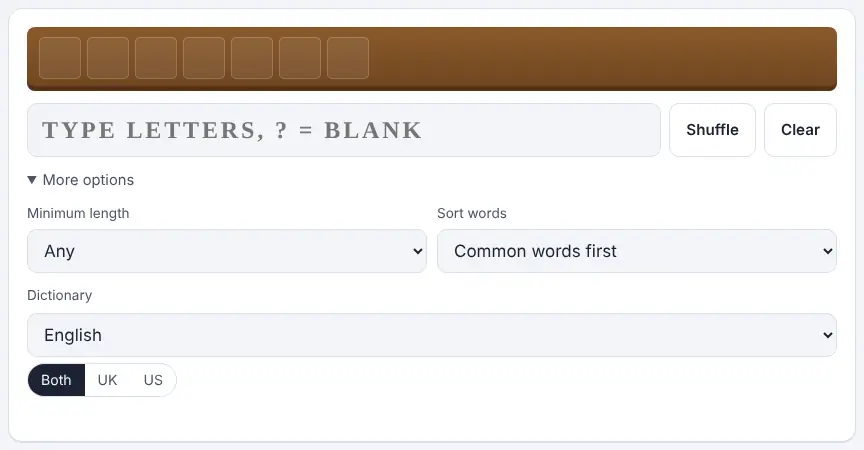
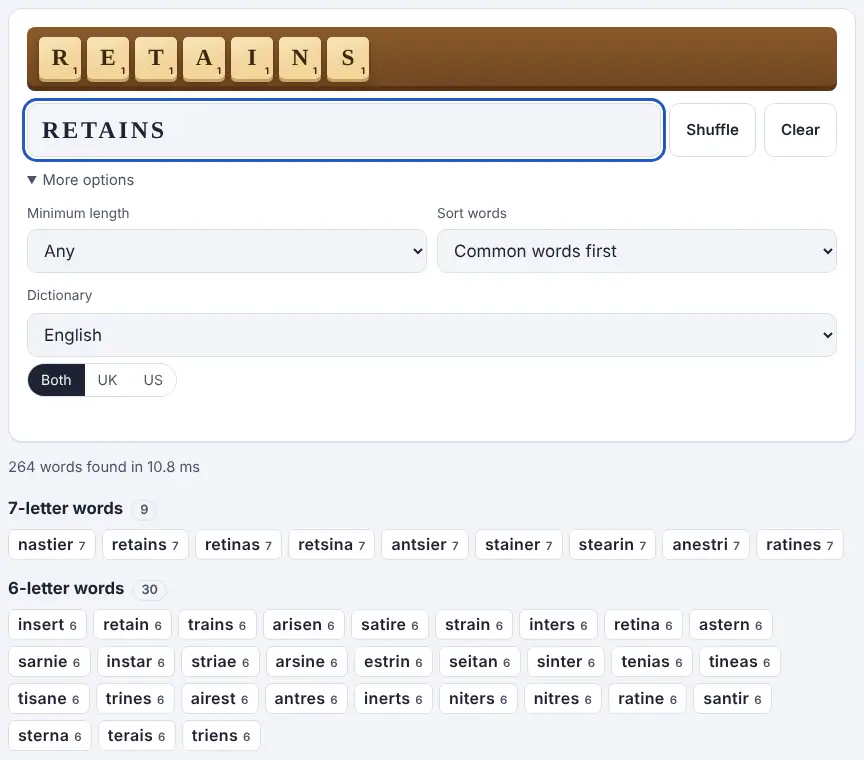
Enter some letters in any order and the tool shows each word they can spell. It respects how many of each letter you have: type one T and you will only see words with a single T, unless you add a blank. A question mark acts as a blank, standing for any letter you might still get.
It is ideal for teachers running spelling and vocabulary starters, parents helping with homework, and anyone playing a letter-tile game who wants to see what their rack can do. Each result is a link to Wiktionary, so an unfamiliar word can be checked in one tap.
How to use it
- Type your letters into the box. Shuffle mixes them up; Clear empties the box.
- Use a question mark to stand for one letter you don’t hold yet – a blank tile, say, or a letter sitting on the board.
- Under More options, choose a Minimum length if you only want longer words, for example four letters or more.
- Pick a sort order: by how common a word is, alphabetically, or by points.
- Under Dictionary choose UK, US or Both spellings, or switch to the word list for another language.
- Tap a word to open its Wiktionary page in a new tab.
More tips
- Unusual game words appear alongside everyday ones. Look up anything odd-looking on Wiktionary before it goes into a lesson.
Ideas for the classroom and home learning
- KS1 (5–7)Choose a short word such as ‘garden’, let pupils make as many little words as they can with letter tiles, then show the list and count together.
- KS2 (7–11)Write a long topic word like ‘playground’ or ‘volcanoes’ on the board. Pairs race to find words inside it; points for every word that also appears in the tool’s list with UK spelling switched on.
- KS3 (11–14)Set a minimum length of five and challenge groups to find words linked to a science or history topic from a set of letters, then explain each meaning.
- KS4 (14–16)Use it for revision of spelling patterns: give letters that hide words with a target pattern (such as -ough or -tion) and ask students to sort the results by pattern.
Learning a language? Take the challenge
Practising a new language? Set the Dictionary to that language and try the same game in it. The word site’s games and solvers have word lists in 21 languages, and its pages are translated into 15. Take a long word in the language you’re learning, see how many shorter words you can pull out of it, then compare with the tool and look up the new ones.
Questions
How is this different from the Word Unscrambler?
Both search the same word lists. Words from Letters is set up for ‘find the words inside’ activities, with a minimum-length filter, while the unscrambler adds Starts with, Ends with, Contains and an exact length.
Can a letter be used twice?
Only if you type it twice. Each letter is used as often as it appears in your box, or you can add a question mark as a blank.
Are all the words child-friendly?
Not always. It uses a general English word list that games accept, which includes some slang and adult words. Check results before projecting them for young children.
Why do some words look strange?
Word-game lists include rare words that people seldom say. Tap one to read its definition on Wiktionary.
Opens Unscramble Words 4U, our free word-puzzle site, in a new tab. Free, with no sign-up.
The source page links to tips for Scrabble®, which belongs to Hasbro (USA and Canada) and Mattel (other countries); Classfern and Unscramble Words 4U are not affiliated with or endorsed by either company.