

Anagram Solver
The Anagram Solver rearranges a word or a jumble of letters into every other word it can become. It is a neat way to explore spelling, letter patterns and wordplay.
Opens Unscramble Words 4U, our free word-puzzle site, in a new tab. Free, with no sign-up.
What it does
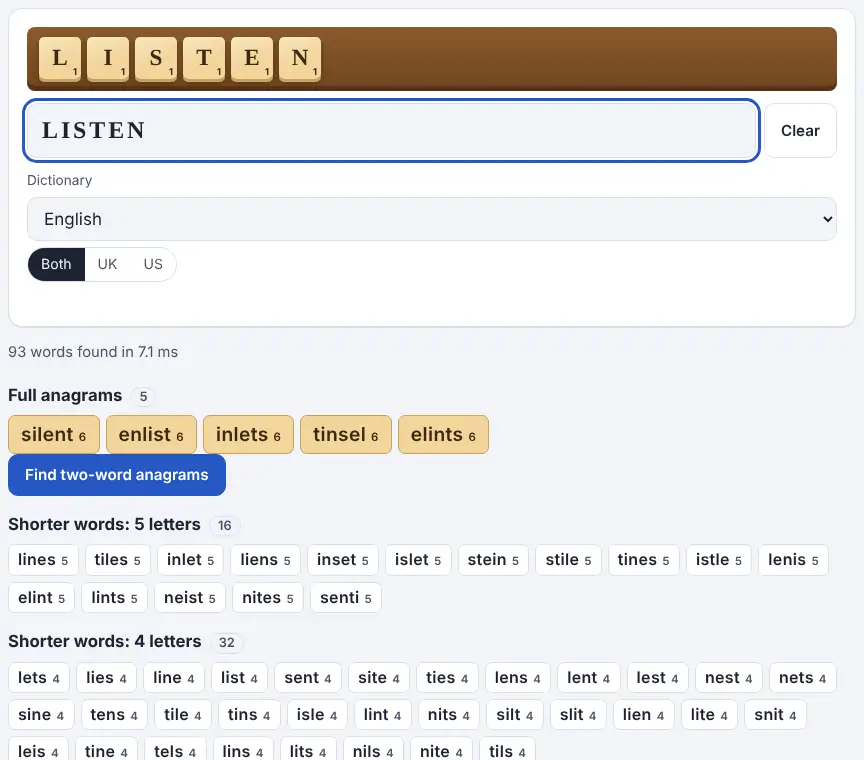
An anagram is a new word made by reordering all the letters of another, each used once – ‘listen’ and ‘silent’ are a classic pair. Type a word and the solver puts any anagrams that use every letter at the top. Underneath, it lists the shorter words those letters can make, grouped by length, which helps when you only need part of the letters.
There is also a two-word search for phrases that share out all the letters across a pair of words. It is useful for crossword fans, word-game players, and teachers who want a quick source of puzzles or a way to check pupils’ answers.
How to use it
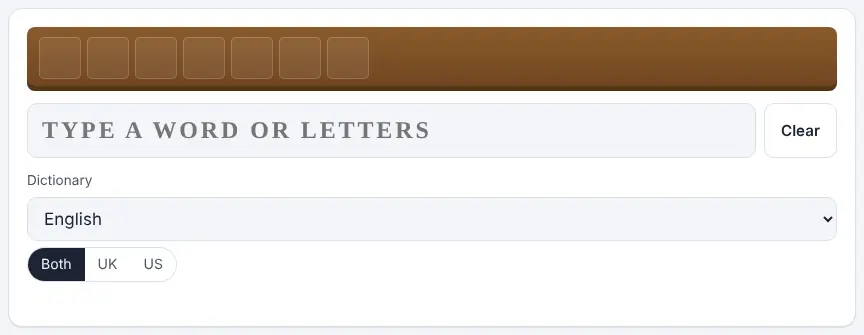
- Type a word or any set of letters into the box. Results appear straight away; press Clear to start over.
- Look at the top section first: these are the anagrams that use every single letter.
- Scroll down for shorter words, sorted into groups by length.
- For four or more letters (with no blanks), a Find two-word anagrams button appears. Press it to search for word pairs. It runs for a couple of seconds, then shows the best pairs it found.
- Add a question mark for a letter you don’t know and the solver will try every letter in that spot.
- Use Dictionary to choose UK, US or Both spellings, or another language’s word list.
More tips
- For a two-part answer such as (5,4), run the two-word search and pick out a pair whose lengths match.
Ideas for the classroom and home learning
- KS2 (7–11)Create an ‘anagram of the day’: pick a word from your spelling list, check in the solver that it has a true anagram (such as ‘heart’ and ‘earth’), and let pupils puzzle it out as a morning starter.
- KS3 (11–14)Ask pupils to find a word with at least three anagrams, then write a short sentence using all of them. It sharpens spelling and shows how letter order changes meaning.
- KS4 (14–16)Introduce cryptic-style clues: show how words like ‘mixed’ or ‘broken’ can signal an anagram, then let students write their own clues and test them on the solver.
- Adult learnersUse the two-word search to make light warm-up puzzles from course vocabulary, and discuss which phrases make sense.
Learning a language? Take the challenge
Learning a language? Change the Dictionary to the language you are studying and look for anagram pairs there. The word site’s games and solvers use word lists in 21 languages, and its pages are translated into 15. Try finding three anagram pairs in your target language this week, and look up any word you have not met before.
Questions
What counts as an anagram?
Any word or phrase that uses exactly the same letters as another, each one once, just in a different order.
Why can’t I see the two-word button?
It only shows when you have entered four or more letters and no blanks. Remove any question marks and it will appear.
Why did the two-word search stop early?
Long inputs can produce a huge number of pairs, so the search is capped at a couple of seconds to keep the page responsive. You still get the best pairs found in that time.
How is this different from the Anagram Generator?
The solver is built for single words and pairs. The generator is aimed at longer names and phrases and can make anagrams of up to three words.
Opens Unscramble Words 4U, our free word-puzzle site, in a new tab. Free, with no sign-up.
Results come from a general word list, so check them before sharing with young children.