

Syllable Counter
Type or paste anything from a single word to a whole poem, and the counter instantly shows how many syllables each word and each line contains. It is a quick check for haiku, limericks, song lyrics and phonics work.
Opens Unscramble Words 4U, our free word-puzzle site, in a new tab. Free, with no sign-up.
What it does
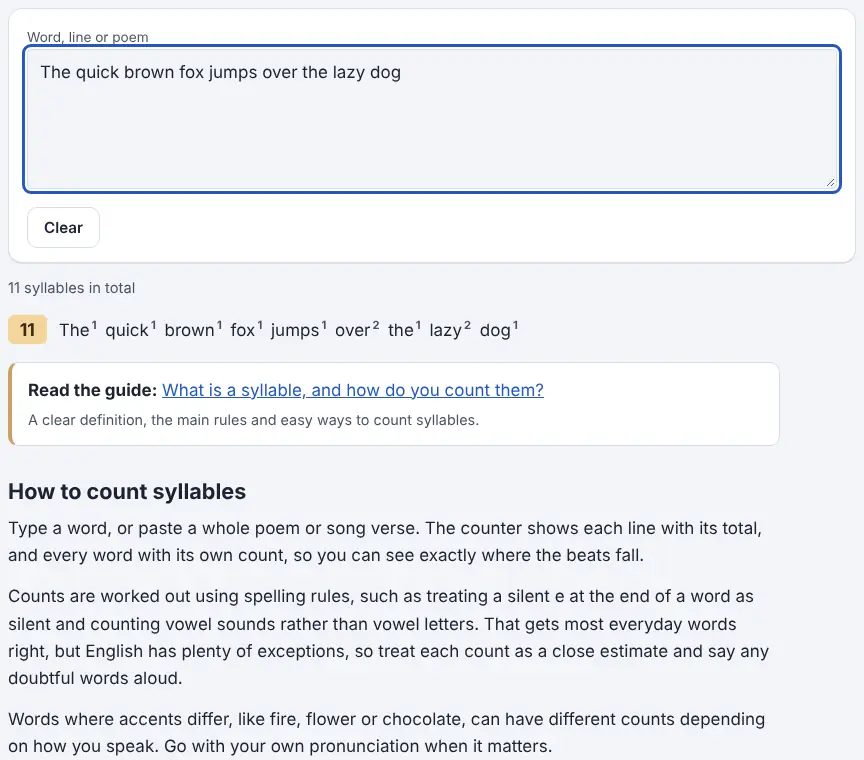
The counter updates as you type. For every line you enter, it gives a line total and breaks it down word by word, and an overall total sits at the top. That makes it easy to see exactly where a line has one beat too many, or which word to swap to make a rhythm work.
Counts are estimated from spelling rules (for example, a final silent e usually doesn’t add a syllable, and what counts is each vowel sound, not each vowel letter) plus a list of common exceptions. That handles the great majority of ordinary words. English is irregular, though, and some words, such as fire, flower or chocolate, are said differently in different accents, so a few counts will differ from how you speak. When it matters, say the word aloud and trust your own pronunciation.
How to use it
- Open the counter in a new tab.
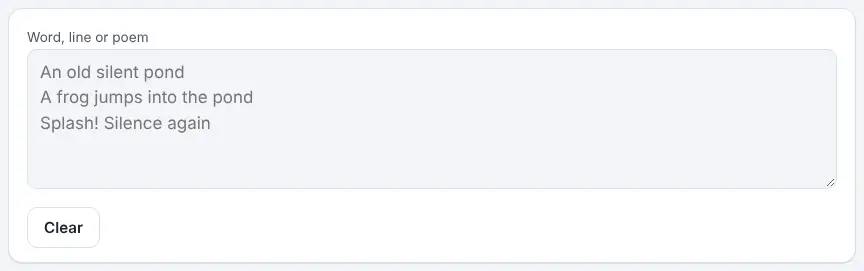
- Type or paste your text into the box. Put each line of a poem on its own line so you get separate line totals.
- Read the total for each line and the count shown beside each word. The grand total appears at the top.
- Edit words and watch the numbers change straight away until the pattern is right.
- Press Clear to empty the box and start again.
More tips
- Compare matching lines in two verses of a song: equal counts usually make words sit more easily on the same tune.
Ideas for the classroom and home learning
- Reception–KS1 (4–7)Clap out children’s names and topic words together, then type them in to see whether the class agreed with the counter. Discuss any word where it disagreed.
- KS2 (7–11)Write class haiku about the seasons. Pupils draft on paper, then use the counter to check their 5–7–5 pattern and revise one word at a time.
- KS2 (7–11)Investigate past-tense endings: why does “jumped” have one syllable but “landed” two? Pupils test a list of verbs and look for the rule.
- KS3–KS4 (11–16)Analyse metre in a poem from your anthology. Paste in a stanza, compare the line counts and talk about where the poet breaks the pattern for effect.
Questions
Is every count correct?
Treat it as a very good estimate. It is rule-based, so unusual words, names and regional pronunciations can differ.
Does it give a total for each line?
Yes. Each line has its own total, every word has its own count, and the overall figure sits above them.
Why does a dictionary sometimes disagree?
Words like every or fire can be said in more than one accepted way. Dictionaries choose one, and the counter goes with the most common.
What is the traditional English haiku pattern?
Three lines: five syllables, then seven, then five again, 17 in total.
Opens Unscramble Words 4U, our free word-puzzle site, in a new tab. Free, with no sign-up.