

Word Finder
The Word Finder lists every word that fits a pattern of known letters and gaps. It is ideal for crosswords, five-letter guessing games and spelling-pattern work.
Opens Unscramble Words 4U, our free word-puzzle site, in a new tab. Free, with no sign-up.
What it does
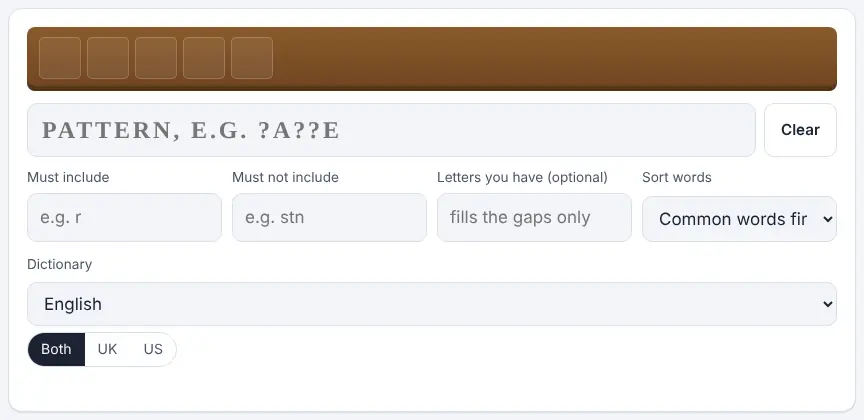
You type the letters you already know in their positions and put a question mark in each empty slot. An underscore or full stop works just as well. Your pattern’s length decides how long the results are, anywhere between 2 and 15 letters, and the list starts with the most familiar words.
Extra boxes let you add letters that must appear somewhere, letters that must not appear, and an optional set of letters you hold, so gaps are only filled from your own tiles. That makes it useful for puzzlers, word-game players and teachers exploring spelling patterns.
How to use it
- Type your pattern in the Pattern box, for example ?a??e finds five-letter words whose second letter is A and last letter is E.
- In Must include, add letters that definitely appear somewhere, even if you’re unsure of their position.
- In Must not include, list letters you have already ruled out.
- If you can only fill gaps from tiles you hold, type them into Letters you have. A question mark there counts as a blank tile.
- Choose a sort order (by commonness, alphabetically, or by points) and pick UK, US or Both spellings, or another language, under Dictionary.
- Tap a word to check its meaning on Wiktionary, or press Clear to start a new search.
More tips
- Short patterns with only one known letter can give hundreds of matches; add crossing letters as you solve to shrink the list.
Ideas for the classroom and home learning
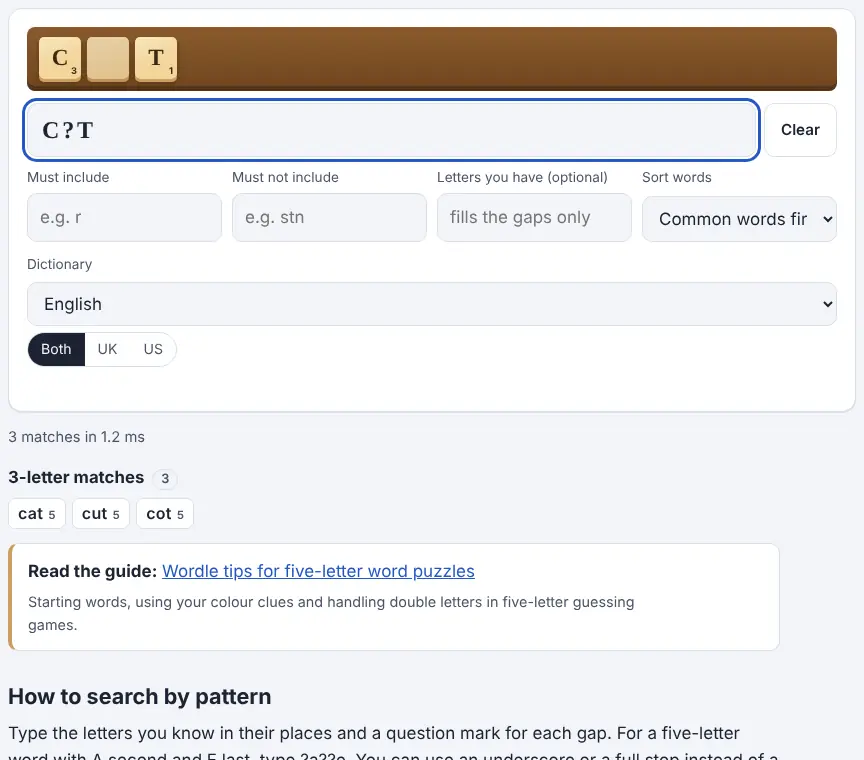
- KS1 (5–7)Search c?t or ?an and read the short list together, talking about how changing one sound changes the word.
- KS2 (7–11)Explore a spelling rule: search patterns such as ????ing or ??igh? and sort the results A to Z for pupils to read, group and copy into their spelling journals.
- KS3 (11–14)Play a class guessing game on the board: the teacher thinks of a five-letter word, pupils guess, and the Word Finder shows how each clue narrows the options – a neat link to logical reasoning.
- KS4 (14–16)Use patterns to check homophones and tricky endings (such as -ance versus -ence) and discuss why the most common results come first.
Learning a language? Take the challenge
Learning another language? Switch the Dictionary to the language you are studying and search for spelling patterns that are typical of it. The word site’s games and solvers use word lists in 21 languages, and its pages are translated into 15. Try a pattern for a common ending in your target language, read the results and note five new words.
Questions
Which symbols mean an unknown letter?
Any of ?, _ or . will do. Every symbol fills exactly one empty slot.
How long can a pattern be?
Anything between 2 and 15 letters. Results always match your pattern’s length.
Why fill in Letters you have?
So that gaps are only filled from those letters, showing just the words your tiles can really spell.
Is there a tool built just for five-letter guessing games?
Yes – the word site also has a Wordle solver where you type in each guess along with the colours it got.
Opens Unscramble Words 4U, our free word-puzzle site, in a new tab. Free, with no sign-up.
Wordle is owned by The New York Times Company. Classfern and Unscramble Words 4U are not affiliated with or endorsed by it.