

Crossword Solver
Stuck on a crossword answer? The Crossword Solver lists every word matching the letters and length you have, with the most common words at the top.
Opens Unscramble Words 4U, our free word-puzzle site, in a new tab. Free, with no sign-up.
What it does
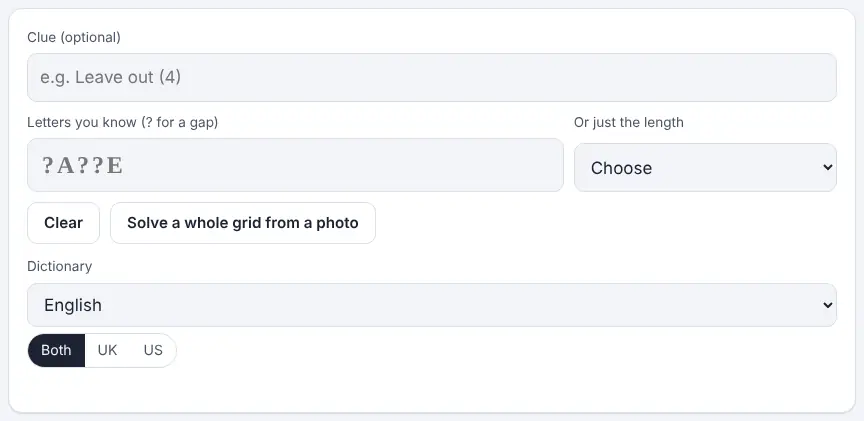
You type in whatever part of the answer you already have, marking each blank square with ?, or, before any letters are known, simply choose a length from 2 to 15. The solver returns every matching word from its dictionary, ordered so everyday words come first, since crossword answers are usually familiar words.
You can also paste the clue. The solver doesn’t understand meaning, but it scans the wording for two well-known tricks: words that hint at an anagram, and answers tucked inside the clue (forwards or backwards). Those suggestions sit in their own section, ready to weigh against the definition.
How to use it
- Put the pattern into Letters you know – for example ?A??E means five letters, the second A and the last E. You may use _ or . in place of ? if you like.
- No letters yet? Leave the pattern empty and choose the answer length from the Or just the length menu.
- Optionally paste the clue into the Clue box. For a multi-word answer, close the clue with the lengths in brackets, such as (4,5), and you will get a list for each part.
- Read the main list, then check any anagram or hidden-word ideas shown separately.
- Choose UK, US or Both spellings under Dictionary, or another language’s word list. Press Clear for a new answer.
More tips
- Working through a whole puzzle? The Crossword Helper rebuilds your grid from a photo so you can fill it in on screen.
Ideas for the classroom and home learning
- KS2 (7–11)After pupils complete a topic crossword, let them check stubborn answers by typing the letters they have. Discuss why several words can fit the same pattern and how the clue decides.
- KS3 (11–14)Give groups a pattern such as ?R??N with no clue. They list all the words they can think of, compare with the solver, then write a clue for one of the answers.
- KS4 (14–16)Use it to introduce how crossword clues are built: show the hidden-word suggestions for a clue and ask students to explain where the answer is concealed.
- Adult learnersPair it with a weekly newspaper crossword for vocabulary practice, looking up each new answer on Wiktionary afterwards.
Learning a language? Take the challenge
Learning a new language? Switch the Dictionary to the language you’re studying and use the pattern search for crosswords in that language. The word site’s games and solvers use word lists in 21 languages, and its pages are translated into 15. Try a simple crossword in your target language and use the solver only when you are truly stuck.
Questions
How do I show a gap?
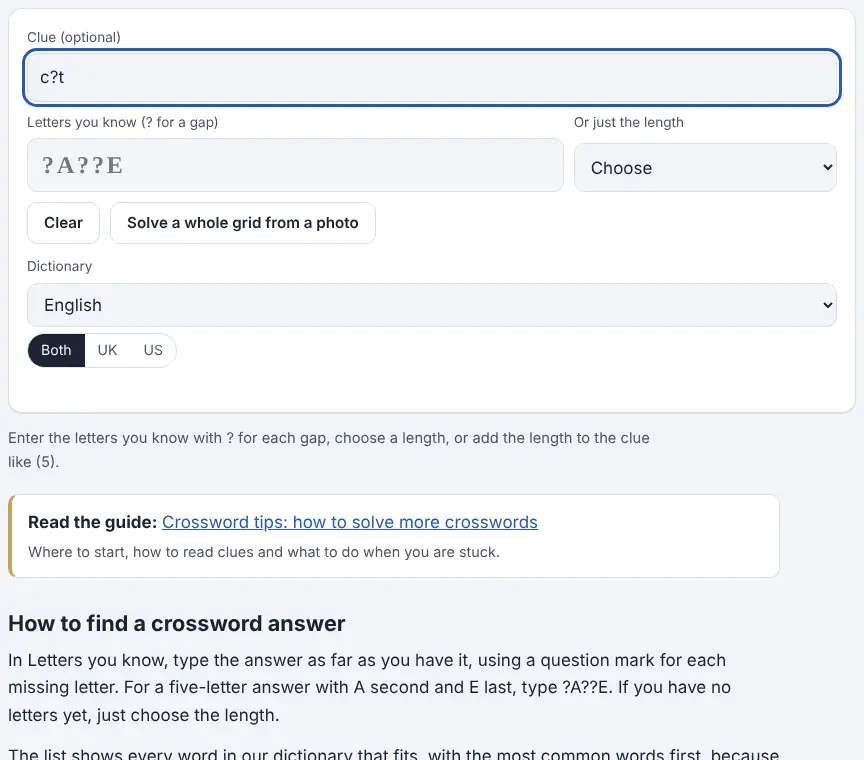
Put ? in each empty spot, as in C?T. Underscores and full stops are accepted too.
Can it work out the clue itself?
Not on its own. It lists words that fit the letters and length and flags possible anagrams and hidden words, but you choose which one suits the clue.
Can it handle answers with more than one word?
Yes. Type the word lengths in brackets after the clue – (3,4), say – and each word gets its own search.
Does it use British or American spelling?
Both are on by default; switch Dictionary to UK or US if your puzzle sticks to one.
Opens Unscramble Words 4U, our free word-puzzle site, in a new tab. Free, with no sign-up.