

Spelling Bee Solver
Honeycomb word puzzles give you seven letters and ask how many words you can build. This free solver lists every word that obeys the rules, with the all-letter words picked out at the top.
Opens Unscramble Words 4U, our free word-puzzle site, in a new tab. Free, with no sign-up.
What it does
In a bee-style puzzle, one letter sits in the middle of the honeycomb and six surround it. Every answer must be four or more letters long and must include the middle letter, while any of the seven may be used repeatedly. The solver applies exactly those rules to its word list and groups the results by length.
When one word manages to include all seven letters, it’s known as a pangram, and it usually scores the most. The solver highlights any pangrams so they stand out. By default it sticks to everyday vocabulary, which is closer to what daily puzzles accept; switch that off to see rarer words as well. It’s handy for checking whether a word is real, and for building vocabulary through letter patterns.
How to use it
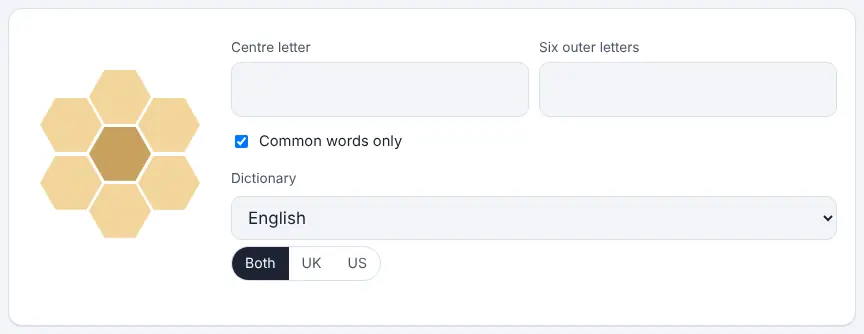
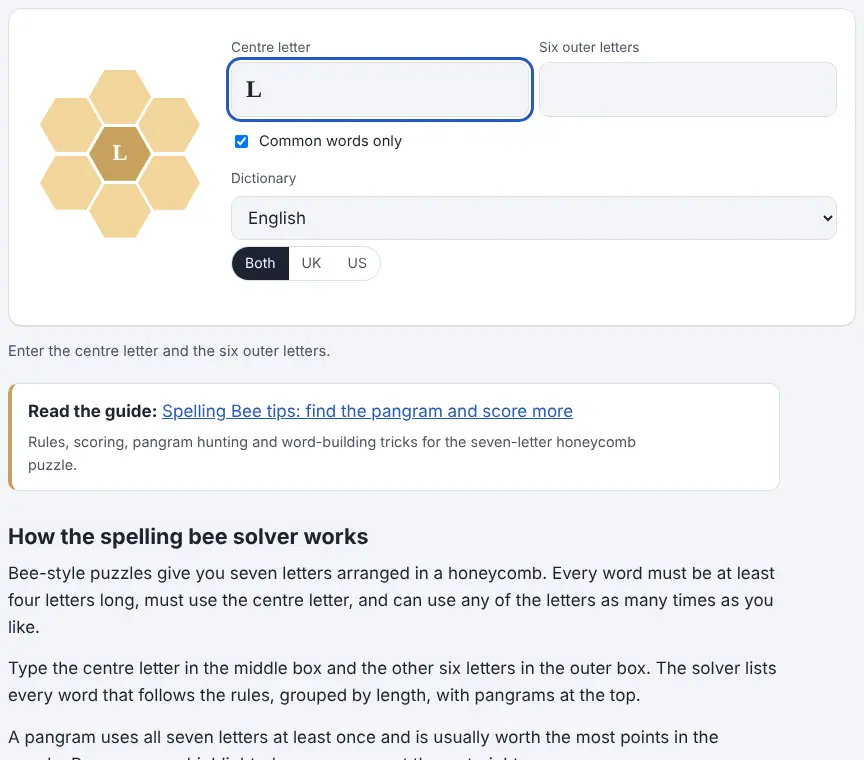
- Type the middle letter into the Centre letter box.
- Type the remaining six into the Six outer letters box, in any order.
- Leave Common words only ticked for the closest match to a daily puzzle, or untick it to include unusual words too.
- Under Dictionary, pick a language and, for English, choose UK, US or Both spellings. For some languages an Ignore accents option also appears.
- Read the results: pangrams come first, then the other words sorted into groups by length.
More tips
- Rarer words may be real but still rejected by a particular daily puzzle, which uses its own hand-chosen answer list.
Ideas for the classroom and home learning
- KS1–KS2 (5–11)Draw a honeycomb with seven letters on the board for a morning starter. The class races to find words, then you reveal how many four-, five- and six-letter words exist as a target.
- KS2 (7–11)Choose letters that contain this week’s spelling pattern (for example, -ight words). Pupils find as many as they can, then compare with the solver’s list.
- KS3 (11–14)Set a ‘pangram hunt’ homework: students find the all-letter word, write a definition and use it in a sentence.
- KS4 (14–16)Untick Common words only and ask students to research three unfamiliar words from the list – a quick vocabulary-extension task.
Learning a language? Take the challenge
Learning another language? Switch the Dictionary to the language you’re studying and try a honeycomb in it. The word site’s games can use word lists in 21 languages, and its pages are translated into 15, so you can build a seven-letter puzzle from French, Spanish, German and many more, then see how many words you can find before checking the list.
Questions
What exactly is a pangram here?
Any word that includes all seven puzzle letters at least once. The solver shows them first and highlights them.
Can a letter appear twice in a word?
Yes. Letters may repeat as often as needed, and the solver follows that rule.
Why are some words not accepted by the puzzle I’m playing?
Each daily puzzle chooses its own answers by hand. The solver draws on a broad word list instead, so leaving Common words only on gives the nearest match.
Opens Unscramble Words 4U, our free word-puzzle site, in a new tab. Free, with no sign-up.
The New York Times Company owns the Spelling Bee trademark. Classfern and Unscramble Words 4U are not affiliated with or endorsed by it.