

Countdown Solver
Practise both halves of the famous letters-and-numbers format. Give this free solver nine letters and it finds the longest words; give it six numbers and a target and it shows how to get there, step by step.
Opens Unscramble Words 4U, our free word-puzzle site, in a new tab. Free, with no sign-up.
What it does
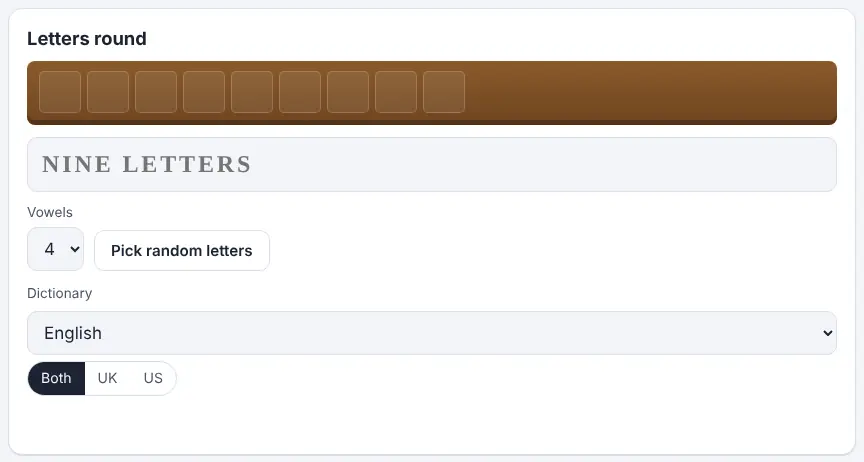
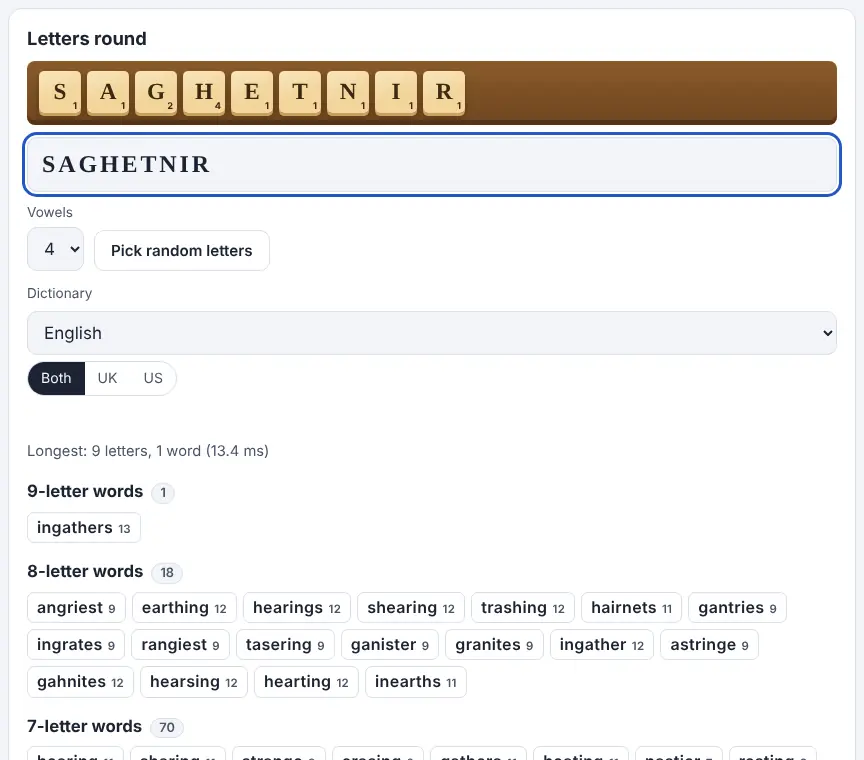
The letters half takes up to nine letters and lists the words they make, longest first; using all nine is the dream, though eight is still a strong result. If you don’t have a set of letters, the tool can deal a random selection with three, four or five vowels.
The numbers half takes six numbers and a target. Using adding, subtracting, multiplying and dividing, with each step producing a positive whole number, it searches for an exact answer that uses as few steps as possible. When the target can’t be hit, it shows the nearest total it can make and the gap to the target. Every line of the working combines two numbers into a new one, so learners can follow and check every move. That makes it excellent for mental arithmetic as much as vocabulary.
How to use it
- For a letters round, type nine letters in the letters box, or choose a number of vowels (3, 4 or 5) and press Pick random letters.
- Set the Dictionary to UK if you want a British-style game without American spellings, or pick US, Both or another language.
- For a numbers round, type in six numbers plus a three-digit target, or choose how many large numbers you want (0 to 4) and press Pick random numbers.
- Press Solve to see the working. Read each line as one small calculation that feeds the next.
- Repeat with fresh letters or numbers for quick practice rounds.
More tips
- In the numbers round, aim first for a multiple of a big number that lands near the target, then use the small ones to make up the difference.
Ideas for the classroom and home learning
- KS2 (7–11)Run a numbers round as a maths starter: generate the numbers, give pupils two minutes on whiteboards, then reveal the solver’s working and compare methods.
- KS2–KS3 (7–14)Play a class letters round with random letters. Pupils score a point per letter in their longest valid word, then check against the solver’s list.
- KS3 (11–14)Use the solver’s step-by-step working to discuss order of operations: how would you write the whole answer as one expression with brackets?
- KS4 (14–16)Ask students to find a target that cannot be reached exactly from a given set, then explain why, using the closest result as evidence.
Learning a language? Take the challenge
Studying another language? Switch the Dictionary to it and play the letters round there instead. The word site’s games can use word lists in 21 languages, and its pages are translated into 15 – a quick, low-pressure way to grow vocabulary in French, Spanish, German and more.
Questions
What are the rules for the numbers?
Use any of the six numbers, each no more than once, with the four basic operations. Every intermediate answer must be a positive whole number.
What if the target is impossible?
You’ll get the nearest reachable total, the size of the gap and the full working.
How are random letters chosen?
You decide the number of vowels and consonants fill the remaining slots. The draw is weighted to resemble a physical pile of letter tiles, so common ones such as E and T appear more often.
Opens Unscramble Words 4U, our free word-puzzle site, in a new tab. Free, with no sign-up.
Countdown is a UK television programme. Classfern and Unscramble Words 4U are independent and are not affiliated with or endorsed by Channel 4 or the programme’s makers.