

Countdown-Style Letters and Numbers Game
A free, browser-based game modelled on the letters and numbers rounds of the long-running TV quiz. It mixes spelling, vocabulary and mental arithmetic, all against a ticking clock.
Opens Unscramble Words 4U, our free word-puzzle site, in a new tab. Free, with no sign-up.
What it does
Each game is made of three kinds of round. In a letters round, players build a board of nine letters by choosing vowels and consonants, then try to make the longest word they can. In a numbers round, six numbers and a random three-digit target appear, and players combine the numbers with +, −, × and ÷ to get as close as possible. The conundrum hides a nine-letter word in a jumble of letters, which has, to be unpicked before time runs out.
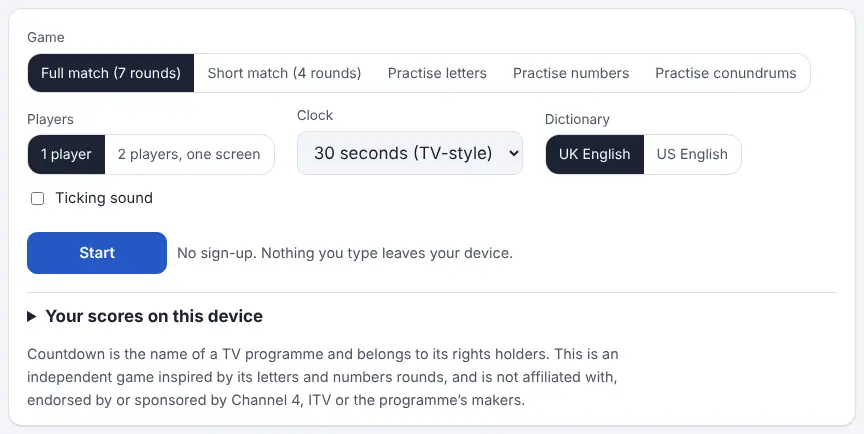
You can play a full seven-round match, a shorter four-round match, or practise just one type of round over and over. One player can play alone, or two can share a single screen. The clock can be set to 30 seconds (as on television), 45 seconds or a learner-friendly 60 seconds. Only when the time is up does the game reveal the best possible answers, which makes every round a mini lesson.
How to use it
- Open the game in a new tab and choose a mode: Full match, Short match, or one of the three practice options (letters, numbers or conundrums).
- Choose 1 player or 2 players, set the clock to 30, 45 or 60 seconds, and pick UK English or US English as the dictionary.
- Press Start. In a letters round, build the board by pressing Vowel or Consonant until nine tiles are showing (the V and C keys also work). The board must end up with a minimum of three vowels and four consonants.
- Type your word or tap the tiles before the clock stops. Each tile may be used once.
- In a numbers round, decide on zero to four large numbers, then work towards the target using the on-screen calculator or by typing your working, such as (50 + 4) × 7.
- For the conundrum, type the unscrambled word and buzz in. You only get one attempt.
More tips
- In the numbers round, every step must give a positive whole number, so encourage pupils to look for multiplications that land near the target first, then adjust.
- Scoring rewards length: a point for every letter, doubled to 18 when all nine are used. Numbers score 10 for hitting the target, 7 for finishing within 5 and 5 for finishing within 10.
Ideas for the classroom and home learning
- KS2 (7–11)Play “Practise numbers” as a whole-class arithmetic starter with the 60-second clock. Pupils write their method on mini whiteboards, then compare it with the solution the game shows.
- KS2 (7–11)Use “Practise letters” for spelling. After each round, ask pupils to spell the best word aloud and identify any prefixes or suffixes it contains.
- KS3 (11–14)Run a two-player knockout tournament on classroom devices. Players take turns on the same letters, which the screen hides while they swap seats, so every pair plays a fair match.
- KS4 (14–16)Use the conundrum rounds as a five-minute vocabulary warm-up before English lessons, asking students to define each nine-letter answer once it is revealed.
Questions
Why was a word rejected?
Every letter in your answer has to come from the nine tiles, no tile can be reused, and the word must be in the chosen word list. Names, abbreviations and offensive words are turned down.
Can pupils use American spellings?
Yes. Choose US English in the set-up box and American spellings are allowed instead of British ones.
Is the ticking sound on by default?
No, it starts switched off. Press the Sound button to hear it, which helps build atmosphere in a class competition.
Are scores saved?
Best scores and the longest word found are kept only in that browser. There is a button to clear them, and no account is needed.
Opens Unscramble Words 4U, our free word-puzzle site, in a new tab. Free, with no sign-up.
Countdown is a TV programme, and its rights holders own the name. Classfern and Unscramble Words 4U have no connection with Channel 4, ITV or the show’s makers, and this game is not endorsed by them.