

Word Lists
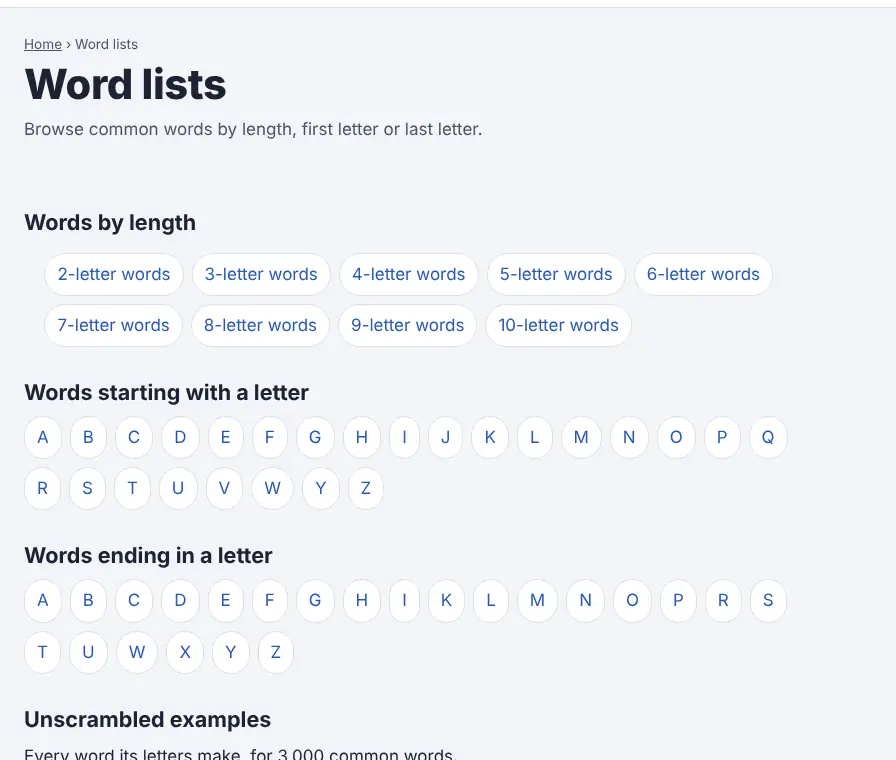
The word site’s word lists hub is a single page that links to every list it offers: words sorted by length, by first letter and by last letter, plus worked unscrambling examples. Think of it as a ready-made word bank for planning.
Opens Unscramble Words 4U, our free word-puzzle site, in a new tab. Free, with no sign-up.
What it does
The hub has four sections. “Words by length” links to nine lists, from two-letter to ten-letter words, each with tile scores. “Words starting with a letter” has a page for every letter except X, and “Words ending in a letter” covers every letter except J, Q and V; each of those pages groups its words by length from three to ten letters. Finally, “Unscrambled examples” shows every word that can be made from the letters of 3,000 common words, arranged by first letter.
None of these lists is a game in itself, but together they cover most of the word-hunting a teacher does when planning: finding short words for early readers, five-letter words for a guessing game, long words for a spelling stretch, or words that end in a particular sound for a rhyme lesson. Each list page is static and loads quickly, so it is easy to project on a whiteboard.
How to use it
- Open the hub in a new tab.
- Decide how you want to search: by length, by first letter or by last letter.
- Click the length or letter you need to open that list.
- On any list page, use the links at the bottom to jump between lengths or letters without going back to the hub.
- To see what one specific word can be rearranged into, choose its first letter under “Unscrambled examples”.
More tips
- Lists from four letters up show only the commonest words for each letter, so they suit classrooms better than a full dictionary.
- For words from a particular set of letters rather than a list, use the unscrambler instead.
Ideas for the classroom and home learning
- KS1 (5–7)Use the 3-letter list to pick CVC words for phonics, and the “words ending in” pages to collect rhyming sets such as words ending in -g or -t.
- KS2 (7–11)Plan a week of spelling starters: Monday a five-letter guessing game, Wednesday a seven-letter tricky-word focus, Friday a nine-letter scramble, all sourced from the length lists.
- KS2 (7–11)Use the unscrambled examples as a model before a “how many words can you make?” challenge, so pupils see how many words hide in one.
- KS3 (11–14)Ask students to compare the size of each length list and graph how the number of common words changes as words get longer, then explain the shape.
Questions
Are the lists in British or American English?
They come from a combined word list, so you will find both spellings, such as behaviour and behavior.
Why is there no page for words starting with X?
The hub doesn’t link one. For X words, try the word finder or the unscrambler’s Starts with option.
Are the lists suitable to show children?
They are drawn from a general word-game dictionary, so preview a list before projecting it.
Opens Unscramble Words 4U, our free word-puzzle site, in a new tab. Free, with no sign-up.
The lists come from a general word-game dictionary and include a few words you may not want young children to see. Preview before projecting.