

Word Ladder
A word ladder links two words of the same length through a chain of real words, swapping just one letter each time – COLD can climb to WARM, for instance. This free tool both solves ladders and gives you fresh ones to play.
Opens Unscramble Words 4U, our free word-puzzle site, in a new tab. Free, with no sign-up.
What it does
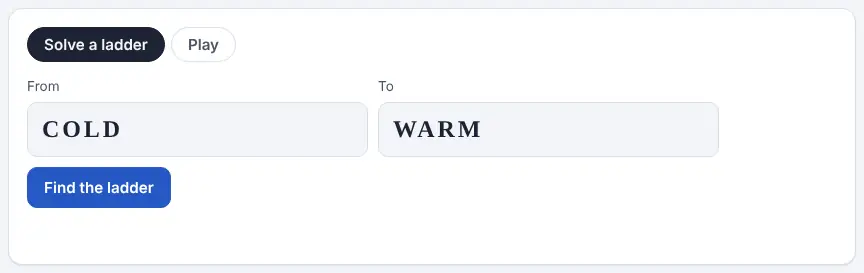
The tool has two modes. Solve a ladder takes a start word and an end word, each up to eight letters and both the same length, and finds the shortest possible chain between them. It works outwards ring by ring – all words one change away, then those two changes away, and so on – until the goal appears, favouring everyday words and turning to rarer ones only when it must. The letter that changes on each rung is highlighted.
Play mode sets you a puzzle: two common words of three, four or five letters plus how many moves the shortest route needs. You type each next rung yourself, and every entry has to be a genuine word one letter different from the one before. The puzzle type is often credited to Lewis Carroll, who published it under the name Doublets in 1879. It’s brilliant for spelling, phonics and vocabulary.
How to use it
- To solve, choose Solve a ladder, type the start word in From and the goal in To, then press Find the ladder.
- Read down the result – the highlighted letter on each line shows what changed.
- To play, choose Play, pick a word length of 3, 4 or 5, and press New puzzle.
- Type your next word and press Add. It must be real and differ by exactly one letter from the previous rung.
- Made a wrong turn? Undo takes back your last step. Show me completes the ladder from wherever you’ve got to.
More tips
- If you’re stuck going forwards, work back from the end word; the last few rungs can be easier to spot.
- Longer words have fewer one-letter neighbours, so ladders between them are rarer and sometimes impossible.
Ideas for the classroom and home learning
- KS1 (5–7)Build a three-letter ladder together on the board, such as CAT to DOG, sounding out each new word. It’s a natural fit for phonics and blending.
- KS2 (7–11)Give pairs a four-letter puzzle from Play mode and see who matches the shortest step count. Use Show me only after everyone has tried.
- KS2–KS3 (7–14)Pupils invent their own start and end words, test them in the solver, and swap with a partner – noting which pairs can’t be joined at all.
- KS3 (11–14)Link to computing: discuss how searching one step out, then two, guarantees the shortest route, and compare that with how pupils search by hand.
Questions
Can I add or drop letters?
No. In a traditional ladder the length stays fixed, and each rung swaps exactly one letter.
Why can’t it join my two words?
A few words have no one-letter neighbours at all, or sit in a cluster that never links to the other word. Pick a different start or end.
How long can the words be?
The solver accepts up to eight letters. Play mode offers three, four or five.
Who came up with word ladders?
They are generally credited to Lewis Carroll, the author of the Alice books, who called them Doublets. Showing pupils one of his puzzles can make a nice link to a literacy unit.
Opens Unscramble Words 4U, our free word-puzzle site, in a new tab. Free, with no sign-up.