

Cryptoquip Solver
The Cryptoquip is a puzzle printed daily in newspapers, in which a short, jokey sentence has had every letter swapped for another. This free helper takes the coded line and its clue and lets you uncover as much or as little as you want.
Opens Unscramble Words 4U, our free word-puzzle site, in a new tab. Free, with no sign-up.
What it does
Each Cryptoquip uses one consistent letter swap, so a coded letter always hides the same real letter. The day’s puzzle comes with a single giveaway, along the lines of ‘Q equals T’. You type the coded sentence and that clue into the solver, and it searches for English words whose letter patterns fit together, producing a sentence that reads naturally.
Because the puzzles are brief and built around puns, more than one reading can occasionally fit. That’s where the key comes in: you fix the letters you trust, solve again, and the joke usually falls into place. The step-by-step reveal makes it a gentle tool for learners who want to keep most of the solving for themselves.
How to use it
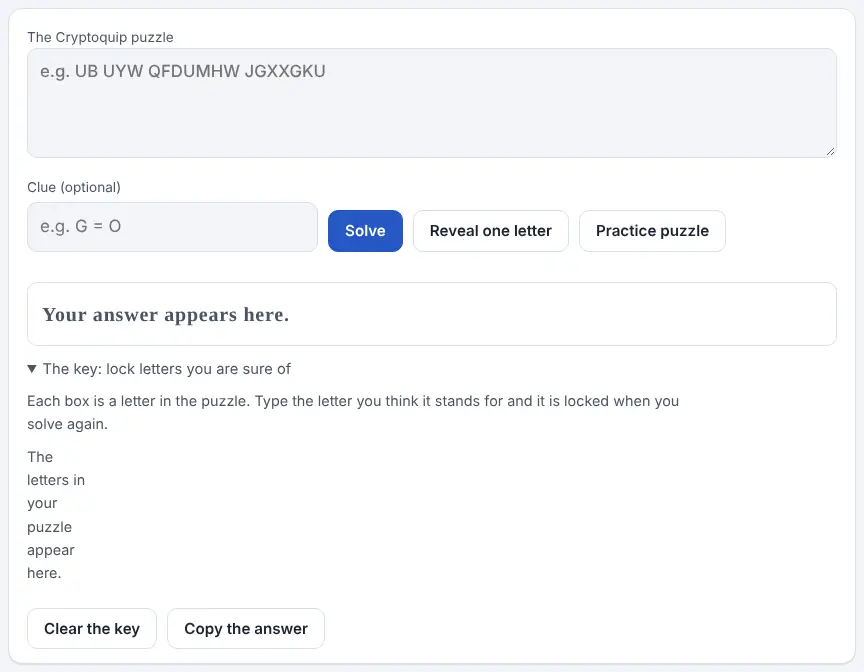
- Type the puzzle into the main box exactly as printed – keep every space and apostrophe, because they carry useful information.
- Enter the day’s clue in the optional Clue box as two letters joined by an equals sign, such as Q = T. Several clues can go in, separated by commas.
- Press Reveal one letter whenever you want a small push; each press uncovers another letter, beginning with whichever appears most.
- Press Solve when you’d like the whole sentence.
- Lock letters you’re sure of by typing them into the key boxes, then solve again. Clear the key resets them, and Copy the answer copies the result.
- No puzzle to hand? Practice puzzle generates a fresh one to try.
More tips
- Look hard at apostrophes. One letter after an apostrophe is very often S or T, and two letters after one frequently spell LL, RE or VE.
- The final few words usually deliver the pun, so think of familiar phrases with a twist once some letters are in.
Ideas for the classroom and home learning
- KS2 (7–11)Write your own simple pun sentence, encode it, and give the class the clue letter. Pupils work in teams, with each team allowed three single-letter reveals.
- KS3 (11–14)Use solved Cryptoquips as a springboard for a lesson on puns and homophones. Pupils explain why the joke works, then write and encode one of their own.
- KS4 (14–16)Pair it with work on apostrophes: students list which letters can follow an apostrophe in English contractions and test their list on a real puzzle.
- Adult learnersA daily Cryptoquip makes a short reading-and-reasoning warm-up for English language learners, with hints keeping it achievable.
Questions
Where do I type the clue?
In the Clue box, written like Q = T. If you have more than one, separate them with commas.
Why did the solver pick an odd word?
Short, punning sentences can sometimes fit two or three answers. Fix the letters you trust in the key and solve again.
Does it know today’s answer?
No – it simply cracks whatever letter-swap puzzle you type in, so it works for any day’s Cryptoquip or for puzzles you make yourself.
Opens Unscramble Words 4U, our free word-puzzle site, in a new tab. Free, with no sign-up.
Classfern and Unscramble Words 4U are independent and are not affiliated with or endorsed by the Cryptoquip or the company that publishes it, nor by any newspaper that carries it.