

Cryptogram Solver
A cryptogram is a sentence where every letter has been traded for a different one, using the same swap throughout. Paste one into this free solver and it recovers the original message – or helps you crack it yourself, one letter at a time.
Opens Unscramble Words 4U, our free word-puzzle site, in a new tab. Free, with no sign-up.
What it does
Cryptograms are simple substitution ciphers: if K means E once, it means E in every word. The solver studies the shape of each coded word – its length and where letters repeat – and searches for real English words with matching shapes that also agree with one another. It then polishes the result by judging how natural the letters read. A sentence or longer is usually cracked in a moment.
For learners, the best feature is control. You can lock letters you’re confident about, add a clue, or uncover a single letter instead of the whole message. There is also a button that builds a fresh practice puzzle from a familiar saying, which is ideal for a starter activity. The work happens in your browser, so nothing you paste is kept.
How to use it
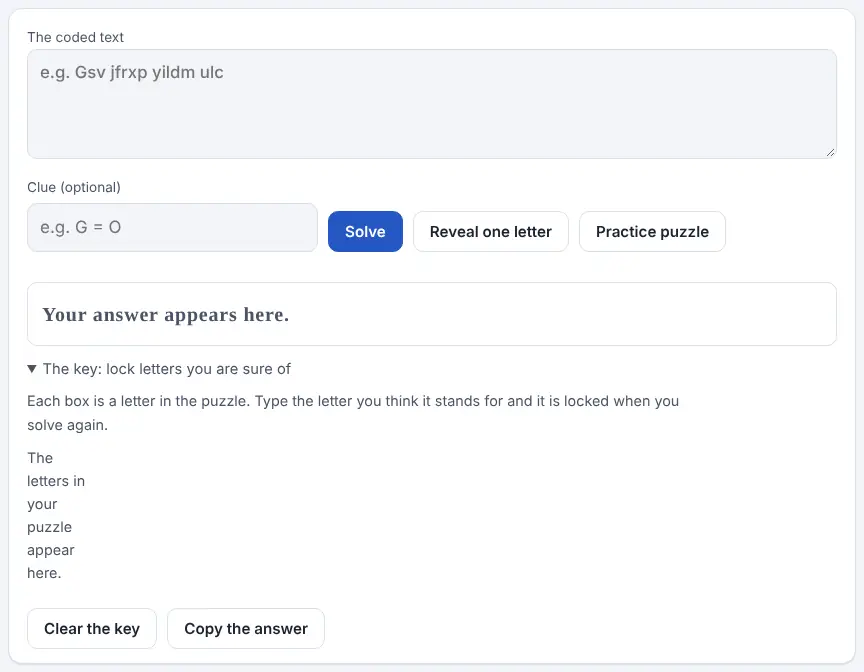
- Paste or type the coded text into the main box, keeping its spaces and punctuation.
- If the puzzle offers a clue, type it into the optional Clue field in the form G = O.
- Press Solve to see the decoded message, or Reveal one letter for a single nudge. Each extra press uncovers another letter, beginning with the commonest one in the puzzle.
- Use the key boxes underneath: each one stands for a coded letter. Type the plain letter you believe it hides, and it stays fixed the next time you solve.
- Clear the key removes your locked letters. Copy the answer puts the decoded text on your clipboard.
- Want something to practise on? Press Practice puzzle to get a brand-new cryptogram.
More tips
- If a name or unusual word throws the result off, lock the letters you know in the key and solve once more – that usually sorts it out.
- Very short puzzles leave little to go on and may fit more than one sensible answer, so a clue letter helps a lot.
Ideas for the classroom and home learning
- KS2 (7–11)Encode a class motto as a cryptogram and give pupils one clue letter. Groups use Reveal one letter only when stuck, keeping a tally of how many nudges they needed.
- KS3 (11–14)Run a frequency investigation: pupils count letters in a long cryptogram, rank them, and test whether the most frequent symbol really does stand for E before checking with the solver.
- KS3–KS4 (11–16)Compare a Caesar shift, which has just 25 possible keys, with a full letter swap, which has vastly more. Discuss why word-shape reasoning beats trying every key.
- KS4 (14–16)Students write their own cryptograms for a partner, swap, solve by hand, and then use the solver to settle disputes – a neat way to revise spellings and punctuation.
Questions
How does this compare with a Caesar shift?
A Caesar cipher slides the whole alphabet by one fixed amount, leaving just 25 shifts to try. A cryptogram can pair letters in any order at all, which is why the solver relies on word patterns instead.
Can a letter be left as itself?
Most published cryptograms avoid that, but the solver doesn’t depend on the rule, so it copes either way.
What if the answer is slightly off?
Lock any letters you’re sure of in the key boxes and press Solve again. Names and rare words are the usual cause.
Opens Unscramble Words 4U, our free word-puzzle site, in a new tab. Free, with no sign-up.
Letter-swap puzzles are great for reasoning practice but offer no real security – they shouldn’t be used to hide anything private.