

Rune Translator
Write names and words in the old runic alphabets of Scandinavia and Anglo-Saxon England, or turn runes back into letters, with three rune sets to choose from.
Opens Unscramble Words 4U, our free word-puzzle site, in a new tab. Free, with no sign-up.
What it does
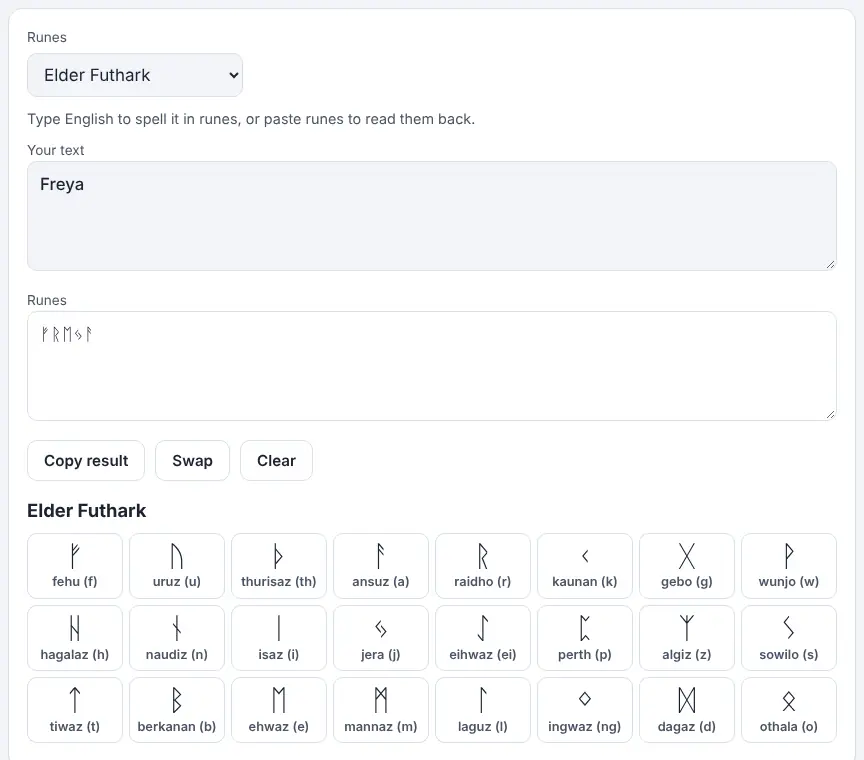
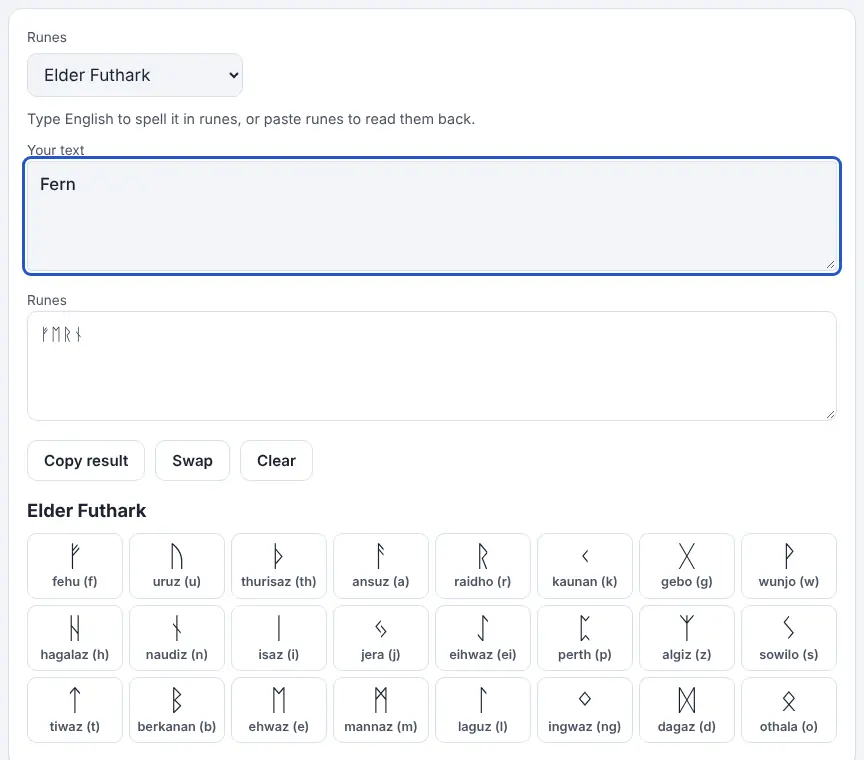
Pick a rune set from the menu (Elder Futhark, Younger Futhark or Anglo-Saxon Futhorc), then type, and the runes build up as you go, with the small dot carvers used to divide words. To go the other way, paste runes in and read the letters, use Swap to move the result into the input, and copy or clear as needed. Charts of every rune with its traditional name sit below the tool.
The tool transliterates: it spells English sounds with runes and does not translate anything into the old Norse or English languages. When a letter lacks its own rune, the nearest sound stands in, while TH and NG each get a dedicated rune. The oldest set, the Elder Futhark, contains 24 runes. The Younger Futhark of Viking Age Scandinavia cut that to 16, so one rune can cover several sounds, such as K and G, and reading back can only give one of the possible letters. The Anglo-Saxon Futhorc, used in England, expanded to around 30 runes and gave English the letter thorn (þ).
How to use it
- Choose a rune set from the menu.
- Type a name or word into the box and watch the runes appear.
- Press Copy result to use the runes elsewhere.
- To read runes, put them into the box; use Swap or Clear as needed.
- Check the charts below to learn each rune's name and sound.
More tips
- For anything permanent, such as a carving, ask someone who knows the old languages and check the spelling carefully.
Ideas for the classroom and homeschool
- Grades 3–5World history: while learning about the Vikings and early England, students write their name in Futhorc and in Younger Futhark and explain the differences.
- Grades 3–5Art: design a rune-inscribed bookmark or clay tablet using the tool's output.
- Grades 6–8Explore why the Younger Futhark had fewer runes yet needed to show more sounds, and what that did to spelling.
- Grades 6–8ELA: trace the letter thorn from runes to Old English manuscripts and its link to 'ye olde' signs.
Questions
Will it give me Old Norse?
No. It only spells English with runes. A true translation would swap in Old Norse words.
Why is my name strange in the Younger Futhark?
That set has just 16 runes, so several letters double up and some sounds are only approximate.
Which rune set should we use in class?
Futhorc suits work on Anglo-Saxon England; Younger Futhark suits the Vikings; Elder Futhark is the oldest and most widely recognized.
Where does the word futhark come from?
It strings together the opening six rune sounds, beginning with F and U and ending with R and K, in the same way that 'alphabet' joins alpha and beta.
Opens Unscramble Words 4U, our free word-puzzle site, in a new tab. Free, with no sign-up.