

Cryptic Crossword Generator
Cryptic crosswords are a British puzzle tradition, less common in the US, where each clue is a little riddle. This free generator creates a new one every time, starting with the easiest clue types, and shows how each answer works once students have found it.
Opens Unscramble Words 4U, our free word-puzzle site, in a new tab. Free, with no sign-up.
What it does
Where a regular crossword clue is simply a definition, a cryptic clue usually has two parts: a straightforward definition at the start or end, plus wordplay that reaches the same answer another way. Take “Dine on mixed tea (3)”: “dine” is the definition, and “mixed tea” tells you to rearrange T, E and A to make EAT. Once students see the pattern, the clues become puzzles they can reason through.
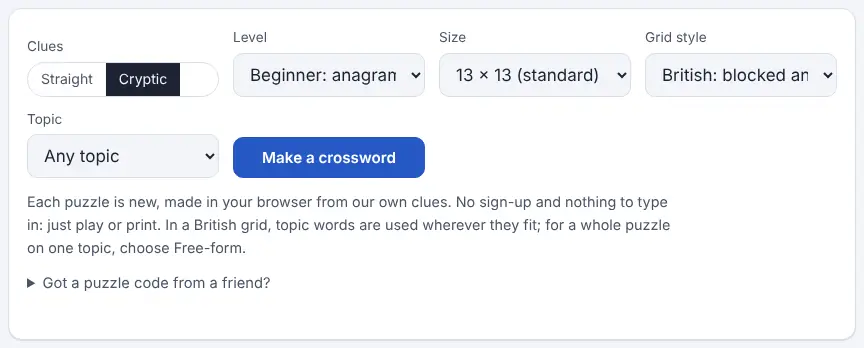
Three levels are available. Beginner uses only anagrams and hidden words, each with a clear signal word. Intermediate adds charades (answers built from smaller pieces), containers, reversals and homophones. Advanced uses every type, including deletions, first-letter clues and “all-in-one” clues where the entire clue doubles as the definition. Once an answer is solved or revealed, a How it works button shows up under that clue to separate the definition from the wordplay. Explanations never show early.
How to use it
- Open the generator in a new tab; “Cryptic” is preselected under Clues.
- Choose Beginner, Intermediate or Advanced, a grid size from 9 × 9 to 15 × 15, and a British or free-form layout.
- If you like, pick a topic (Beginner offers the most). Themed puzzles are best with the free-form layout.
- Click “Make a crossword”, then click a square or clue and type.
- If students get stuck, reveal a letter or word and click How it works to watch the clue being taken apart.
- Click Print to get the grid and clues on the first sheet and an answer key with explanations on the second. Share the code so others can try the identical grid.
More tips
- Watch for signal words. “Mixed”, “broken” or “wild” often mean an anagram; “in” or “some” can hint at a hidden word; “back” can mean a reversal.
- Check the letter count and make sure both halves of the clue point to the same answer before filling it in.
Ideas for the classroom and homeschool
- Grades 3–5With strong 5th-grade readers, display a Beginner 9 × 9 puzzle and hunt for hidden-word answers together. Finding a word hiding inside a phrase builds careful reading and spelling.
- Grades 6–8Introduce one clue type a week. Reveal an answer, read its How it works explanation as a class, then have students write their own clue of that type.
- Grades 9–12Use Intermediate puzzles in ELA to study homophones, double meanings and figurative language, and how puzzle writers play with them.
- Grades 9–12Start a puzzle club with Advanced grids, using the printed answer keys so members can check and debate their solutions.
Questions
Why is it called “cryptic”?
Because each clue hides its answer in wordplay as well as giving a definition. The style is common in British newspapers and less familiar in American ones.
Will explanations spoil the puzzle?
No. Each How it works explanation only unlocks after that answer has been solved or revealed.
Is the spelling American?
No. Answers use British spelling, which is worth mentioning to students before they start.
Can we switch to regular clues?
Yes. Choose “Straight” under Clues at any time for a standard crossword.
Opens Unscramble Words 4U, our free word-puzzle site, in a new tab. Free, with no sign-up.