

Cryptic Crossword Solver
Cryptic crosswords, a favorite in British newspapers, are packed with wordplay. This solver tackles the two clue types a computer can test mechanically – anagrams and hidden words – while also listing every dictionary word that matches your crossing letters.
Opens Unscramble Words 4U, our free word-puzzle site, in a new tab. Free, with no sign-up.
What it does
Most cryptic clues combine two pieces: a plain definition at one end, plus wordplay that reaches the same answer by a trickier path. That wordplay can be nearly anything – sound-alikes, one word tucked inside another, first letters, abbreviations – and the solver doesn’t try to decode every style. It sticks to anagrams and hidden answers, then shows the complete list of words that suit your pattern.
When the clue includes a word hinting at rearrangement, like ‘broken’, ‘confused’, ‘wild’ or ‘odd’, the solver tests neighboring groups of words with the correct letter total and reports any shuffles that suit your pattern. It also reads straight through the clue in both directions, looking for a genuine word concealed inside. Behind the scenes it is the same search as the Crossword Solver, presented for cryptic fans.
How to use it
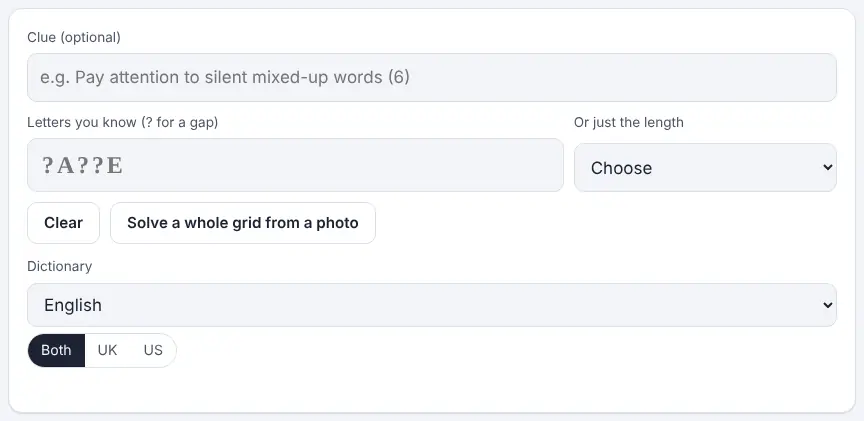
- Paste the clue into the Clue box and close it with the answer length in parentheses, for instance (6) or (3,4).
- Enter any crossing letters in Letters you know, using ? for each square still empty. No letters yet? Pick a length from the menu.
- Read the anagram and hidden-word suggestions and test each one against the definition, which usually sits at the beginning or the end.
- Scan the full list of fitting words to try out other ideas.
- Set Dictionary to US, UK or Both, and press Clear before moving on to the next clue.
More tips
- Small words like ‘in’, ‘some’ or ‘part of’ often point to a hidden answer; ‘back’ or ‘returning’ can mean it reads in reverse.
- If none of the suggestions works, choose the letters yourself and try them in the Anagram Solver.
Ideas for the classroom and homeschool
- Grades 6–8Introduce hidden-word clues: write a sentence that hides a word across the gap between two words, then have students write their own and see if the solver finds them.
- Grades 9–10Teach the two-part structure with an easy anagram clue. Students underline the definition, circle the signal word and box the fodder, then confirm with the solver.
- Grades 11–12Run a clue-writing contest on a class novel: each student writes one anagram clue and one hidden-word clue about a key theme, and classmates solve them.
- Adult learnersUse cryptic clues as a playful way into double meanings and how context changes the way we read a sentence.
Learning a language? Take the challenge
Studying another language? Switch the Dictionary to the language you are learning and use the pattern search to test crossword answers in it. The word site’s games and solvers use word lists in 21 languages, and its pages are available in 15. Try writing a simple hidden-word clue in your target language and check that the solver spots your answer.
Questions
Will it explain every kind of cryptic wordplay?
No. It handles anagrams and hidden words, which a computer can test letter by letter, and shows the words matching your pattern. Everything else depends on your own reading of the clue.
What does ‘anagram indicator’ mean?
It is a word in the clue – ‘mixed’, ‘novel’ or ‘out’, for example – hinting that some nearby letters need reordering.
Where does the answer length go?
Add it in parentheses after the clue, like (7) or (3,4). Alternatively, enter the known letters with ? for each gap.
Is it different from the Crossword Solver?
The search underneath is identical; this version explains the cryptic tricks it checks. For a full grid, use the Crossword Helper.
Opens Unscramble Words 4U, our free word-puzzle site, in a new tab. Free, with no sign-up.