

Vigenère Cipher
The Vigenère cipher uses a keyword to give each letter a different shift. This tool encodes, decodes and can even hunt for a missing key.
Opens Unscramble Words 4U, our free word-puzzle site, in a new tab. Free, with no sign-up.
What it does
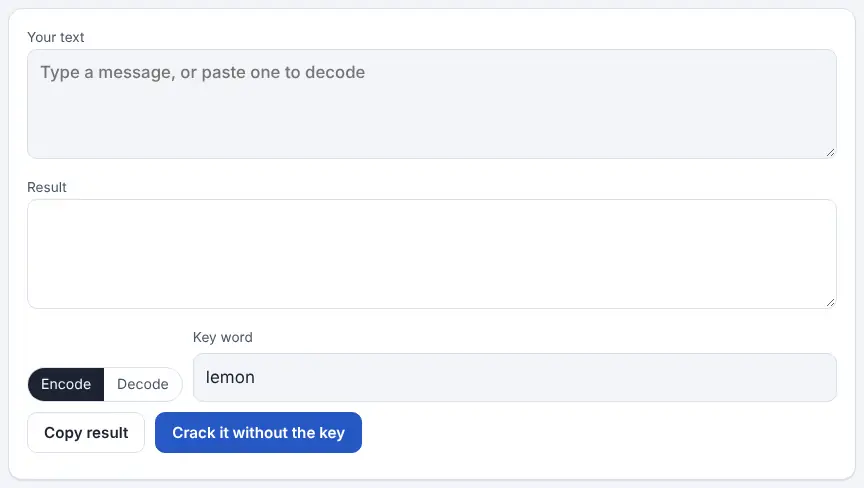
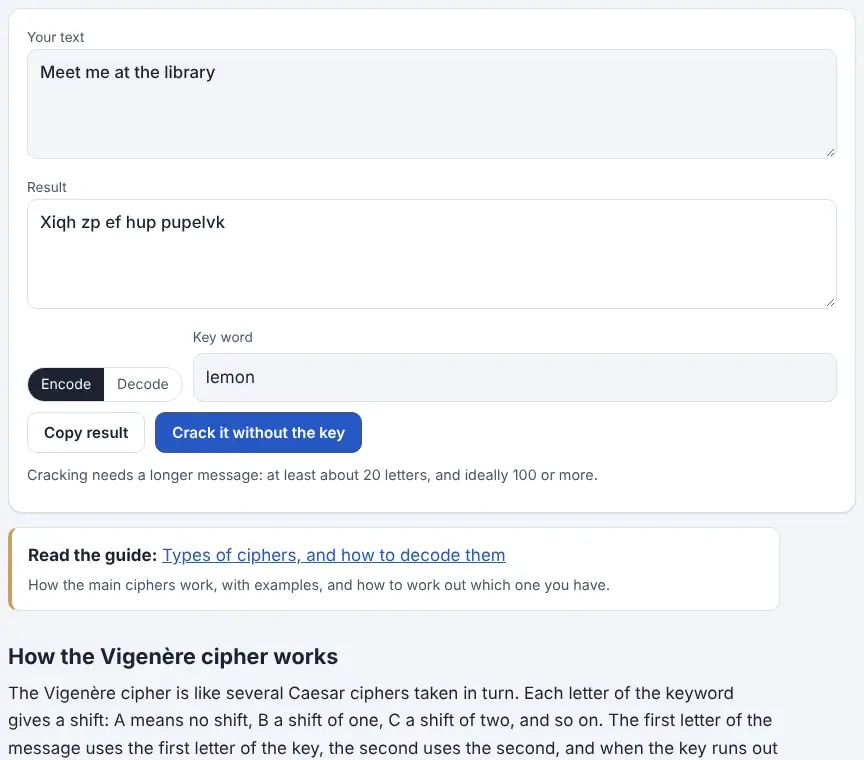
Think of Vigenère as a run of Caesar ciphers taking turns. Each keyword letter sets a shift (A means none, B means one, C means two and so on), and the keyword repeats along the message. Type your text, enter a keyword such as LEMON, then pick Encode or Decode. Letters are the only characters altered, and the key only moves forward when it is used on a letter, so spaces and punctuation stay where they are.
The Crack it without the key button tries every key length between 1 and 16 letters, works out the likeliest shift for each position, and offers the best few keys with their decoded text for you to pick from. It works best on long messages; around a hundred letters or more usually gives a clear winner. Historically, the method was described by Giovan Battista Bellaso in 1553 and later credited to Blaise de Vigenère. It was long thought unbreakable until methods published in the 1800s showed otherwise.
How to use it
- Type or paste your message into the text box.
- Enter a keyword using letters only; anything else is ignored.
- Choose Encode to hide the message or Decode to reveal it with the same keyword.
- Press Copy result to use the output elsewhere.
- No keyword? Use the "Crack it without the key" button, then pick one of the suggested keys to apply it.
More tips
- If the cracker picks a wrong key, there is probably not enough text; give it a longer passage.
Ideas for the classroom and home learning
- KS2 (7–11)Upper KS2: after mastering Caesar, pairs agree a three-letter keyword and send each other a one-line message.
- KS3 (11–14)Compare a Caesar and a Vigenère version of the same sentence and count how often each coded letter appears.
- KS3 (11–14)History of ideas: discuss why a cipher once called 'indecipherable' was eventually broken, and how that changed code-making.
- KS4 (14–16)Computing: investigate how key length affects the cracker's success and present the results as a short report.
Questions
Can my keyword include spaces or digits?
No. The key uses letters alone; any other character is skipped.
Why did the cracker suggest the wrong key?
With a short text, each position in the key has too few letters to analyse. Try a longer passage.
How is it different from Caesar?
Caesar uses one shift for every letter. Vigenère changes the shift letter by letter according to the keyword.
Is Vigenère secure today?
No. Counting letter patterns defeats it, which is exactly what the cracker demonstrates, so keep it for puzzles and lessons.
Opens Unscramble Words 4U, our free word-puzzle site, in a new tab. Free, with no sign-up.
Vigenère is a historical cipher for puzzles and learning, not a way to protect real information.