

Atbash Cipher
Atbash turns the alphabet back to front: A pairs with Z, B with Y, and so on. One simple step both hides and reveals a message.
Opens Unscramble Words 4U, our free word-puzzle site, in a new tab. Free, with no sign-up.
What it does
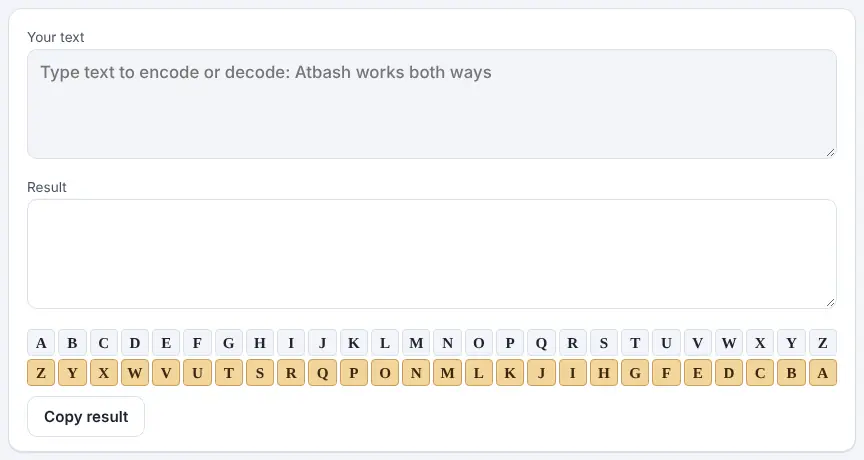
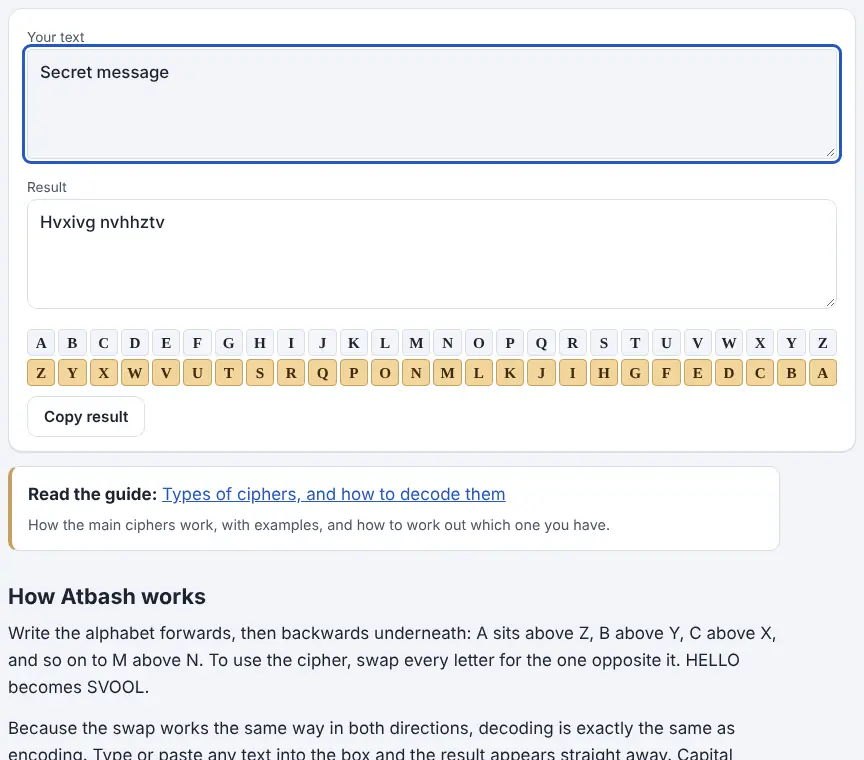
Picture the alphabet written left to right with the same letters written right to left underneath. Each letter is replaced by its partner in the other row, so CAT becomes XZG. Because the pairs work in both directions, there is no separate decode button: paste a coded message in and the plain text appears, or type plain text and get code. Results update as you type, and capitals, spaces, numbers and punctuation are kept.
Atbash started as a way of reversing the Hebrew alphabet; its name joins aleph, tav, bet and shin, the letters found at each end of that alphabet and their next-door neighbours. Its use in some ancient Hebrew writing is a nice talking point for history or RE lessons. It has no key, so anybody familiar with the method can undo it, which makes it ideal for quick puzzles, younger code-breakers and escape-room clues rather than anything private.
How to use it
- Type or paste text into the box.
- Watch the result appear straight away underneath.
- To decode, paste the coded message in exactly the same way.
- Press Copy result to use the answer in a worksheet, card or game.
More tips
- Contrast it with ROT13: both undo themselves, but ROT13 shifts while Atbash reflects.
- Older learners can try decoding by hand first, then use the tool only to check, which builds speed and confidence.
Ideas for the classroom and home learning
- KS1 (5–7)Give a printed mirror-alphabet strip and a three-letter word to decode, then check with the tool together.
- KS2 (7–11)Treasure trail: each clue is in Atbash, and pupils use a paper key before confirming on the tool.
- KS3 (11–14)Maths: describe the Atbash rule as a reflection and write it using letter positions (position becomes 27 minus position).
- KS3 (11–14)RE or history: briefly explore the Hebrew origin of the name and how the cipher was used in ancient writing.
Questions
How do I decode Atbash?
Put the coded text in. Because each pair simply swaps back, the readable version shows at once, with no extra settings.
Is there a key?
No. The reversal never changes, which is exactly why it is so easy to undo.
Are numbers changed?
No, only letters are swapped.
What if a puzzle uses a jumbled alphabet instead?
That is a general substitution cipher; the cryptogram solver is built for it.
Opens Unscramble Words 4U, our free word-puzzle site, in a new tab. Free, with no sign-up.
Atbash has no key and offers no real security. Use it for fun and learning only.