

Cryptic Crossword Generator
Cryptic crosswords can look baffling at first, but they follow rules that can be learned. This free generator builds a new cryptic puzzle every time, starting with the simplest clue types, and explains every answer once you have found it.
Opens Unscramble Words 4U, our free word-puzzle site, in a new tab. Free, with no sign-up.
What it does
The generator works like its straight-clue sister tool, but the clues are cryptic. Most cryptic clues have two halves: a plain definition at one end, and wordplay that leads to the same answer in a different way. For example, in a clue like “Dine on mixed tea (3)”, “dine” is the definition and “mixed tea” tells you to rearrange T, E and A to get EAT.
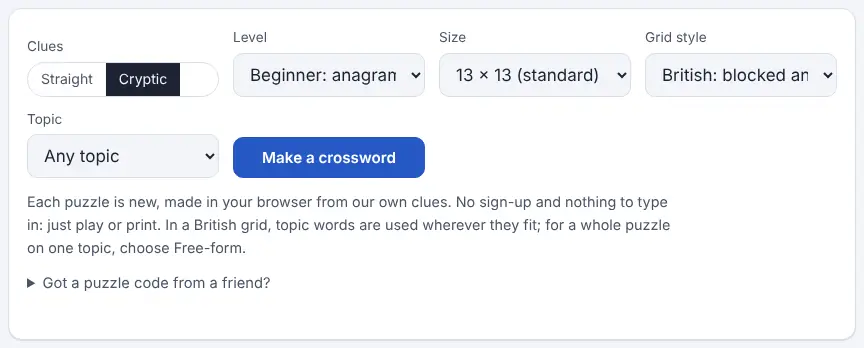
There are three levels. Beginner sticks to anagrams and hidden words, each flagged by an obvious signal word. Intermediate adds charades (an answer assembled from smaller parts), containers, reversals and sound-alike clues. Advanced brings in every kind, including deletions, first-letter clues and “all-in-one” clues in which the entire clue doubles as the definition. When an answer has been solved or revealed, the How it works button shows up beneath that clue and breaks it into definition and wordplay. Explanations stay hidden until then, so nothing is spoiled.
How to use it
- Open the generator in a new tab; “Cryptic” is already chosen under Clues.
- Pick Beginner, Intermediate or Advanced, then a grid size from 9 × 9 to 15 × 15 and a British or free-form grid.
- Optionally choose a topic (Beginner has the widest choice). Topic puzzles work best with a free-form grid.
- Press “Make a crossword”, then select a square or clue and type your answers.
- Stuck? Reveal a letter or word, then use How it works to see the clue taken apart step by step.
- Press Print to get the grid and clues on the first sheet and the solutions, with their explanations, on the second. Share the puzzle code so others can try the same grid.
More tips
- Signal words matter: “mixed”, “broken” or “wild” often mean an anagram, “in” or “some” can point to a hidden word, and “back” can mean a reversal.
- Count the letters the answer needs and check that the definition and the wordplay both give the same word before you write it in.
Ideas for the classroom and home learning
- KS2 (7–11)With confident readers in Year 6, project a Beginner 9 × 9 puzzle and solve the hidden-word clues together. Spotting a word tucked inside a phrase is a great exercise in close reading and spelling.
- KS3 (11–14)Teach one clue type per lesson. Reveal an answer, read the How it works explanation aloud, then ask pupils to write their own clue of the same type.
- KS4 (14–16)Use Intermediate puzzles to explore homophones and wordplay in English language lessons. Discuss how setters exploit words with more than one meaning.
- Sixth form (16–18)Run a lunchtime puzzle club with Advanced grids. Print the answer pages so members can mark and discuss their solutions.
Questions
Is this too hard for beginners?
Not at Beginner level. Pick the smallest grid: all its clues are anagrams or hidden words with an obvious signal, and you can reveal answers and read how they work.
Will the explanations give the game away?
No. Each explanation only becomes available once that answer has been solved or revealed.
Can I switch to normal clues?
Yes. Choose “Straight” under Clues whenever you like and the generator makes ordinary crosswords instead.
Are the clues taken from newspapers?
No. The clues were written for the word site, and all answers are family-friendly, with British spelling.
Opens Unscramble Words 4U, our free word-puzzle site, in a new tab. Free, with no sign-up.