

SOS in Morse Code
SOS is three short signals, three long, then three short: ...---... It is the most famous pattern in Morse, and a great way to teach both the code and emergency safety.
Opens Unscramble Words 4U, our free word-puzzle site, in a new tab. Free, with no sign-up.
What it does
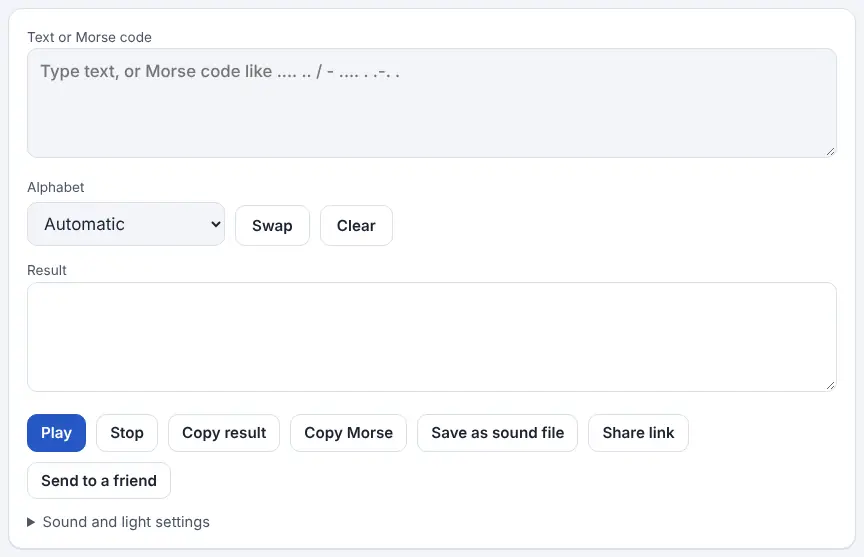
The SOS in Morse Code page on Unscramble Words 4U shows the distress signal and includes the full Morse translator. You can play SOS as sound, watch it as a screen flash or a bright full-screen light (the tool calls it torch mode – ‘torch’ is the British word for flashlight), feel it as phone vibration, save it as a WAV file, and adjust the speed and tone. The page explains that SOS is sent as one continuous pattern, without the normal pauses between letters, so it is heard as a single call, not as three letters in a row.
It also covers some well-established history. In 1906, countries meeting in Berlin for the International Radiotelegraph Convention agreed on SOS as the worldwide distress call, and the rule took effect in 1908. Planners chose it because the rhythm is simple and stands out even through static and interference. Popular sayings such as ‘save our souls’ were invented afterwards – the letters were never an abbreviation. The page describes other ways to show the pattern without a radio: flashes of light, blasts on a whistle, knocks on a surface, or large letters laid out on the ground to be seen from above.
How to use it
- Open the page to see SOS and its dots and dashes at the top.
- Press Play to hear the signal, and slow it down in the sound and light settings if needed.
- Check the flash option to see the timing as light – useful for showing how a flashlight signal would look.
- Compare it with S and O sent as normal letters by typing S O S with spaces into the box.
- Save the audio file if you want to play it in an assembly or safety lesson.
More tips
- Make the safety message part of every SOS activity, not an afterthought.
- The bright full-screen mode is designed for signaling, but in class the gentler screen flash is usually enough.
Ideas for the classroom and homeschool
- Grades K–2Personal safety: clap the SOS rhythm, then practice what to do in a real emergency – find a trusted adult and know that 911 is the number to call.
- Grades 3–5Social studies: explore why the world needed one agreed distress signal in the early days of radio at sea, and why international agreements matter.
- Grades 3–5Outdoor education: before a field trip or camp, discuss whistle signals and how people can be spotted from the air, linking to map skills and staying with the group.
- Grades 6–8Science: investigate which signal – sound, light or ground letters – would travel farthest in fog, at night or across a canyon, and explain why.
Questions
What does SOS stand for?
Nothing. It was chosen for its clear, distinctive rhythm. ‘Save our souls’ is a later phrase made to fit the letters.
Why are there no gaps between the letters?
Running the nine signals together makes SOS one unmistakable signal rather than three letters that could be misheard.
What should someone do if they are truly in danger?
If you have a phone, call 911 first (the number in the USA and Canada). Morse and other signals are a backup for when a phone can’t be used.
Is it OK to send SOS for fun?
Practicing in a classroom is fine. Never send a false distress signal by radio, light or any other means where real rescuers might see or hear it.
Opens Unscramble Words 4U, our free word-puzzle site, in a new tab. Free, with no sign-up.
SOS is for real emergencies only. In danger, call 911 first. Never send a false distress signal. Flashing light can affect people with photosensitive epilepsy.