

Morse Code Alphabet
A clickable Morse chart where every letter, digit and signal plays its own sound – perfect for learning the code by ear instead of staring at dots.
Opens Unscramble Words 4U, our free word-puzzle site, in a new tab. Free, with no sign-up.
What it does
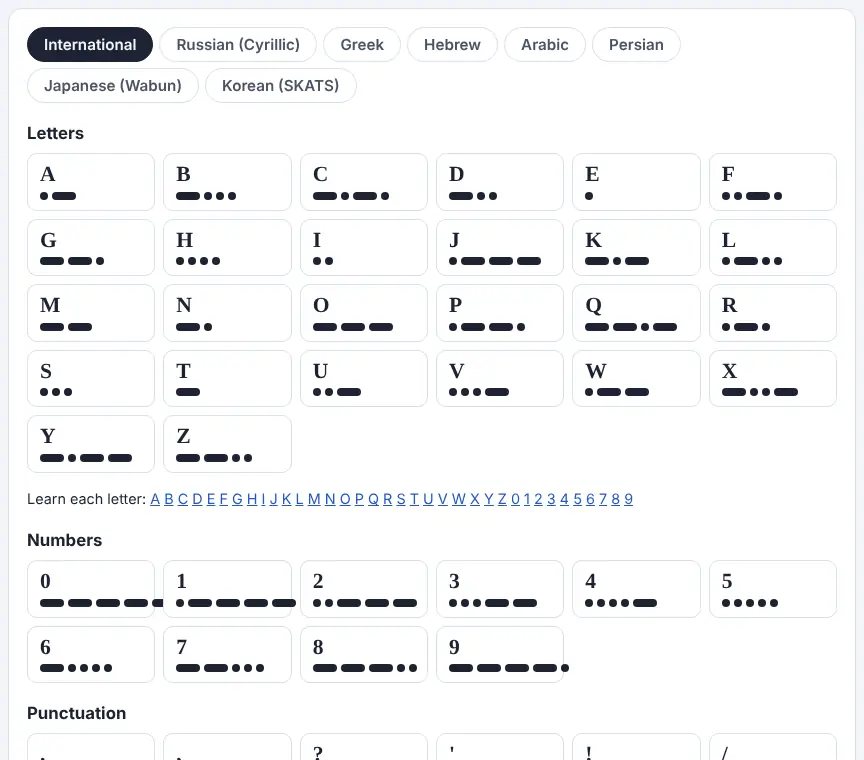
The Morse Code Alphabet page on Unscramble Words 4U lays out International Morse in groups: the 26 letters, the numbers 0 to 9, punctuation, accented letters and procedure signals (prosigns) like SOS, AR and SK. Tap any code and it plays. Tabs at the top switch the chart to the Morse systems used for Greek, Russian, Hebrew, Arabic, Persian, Korean (SKATS) and Japanese (Wabun), and the standard sound and light settings let you change the speed, spacing, pitch and volume.
Besides the main chart there are 36 single-character pages, one for each letter A–Z and each digit 0–9, linked from the chart. Each one plays the character, gives its ‘di-dah’ rhythm, counts its dots, dashes and time units, points out letters that mirror or reverse it, and lists everyday words that start with it, each with a play button. Together they make a handy reference for students, scout troops, escape-room designers and beginners of any age.
How to use it
- Open the alphabet chart. International Morse appears first.
- Tap a letter to hear it. Try to remember the rhythm as a whole, not the count of dots.
- Scroll down for numbers, punctuation, accented letters and prosigns.
- Use the tabs to view another writing system’s Morse table.
- Click a letter in the row of links to open its own page, with memory tips and example words to play.
- Open the sound and light settings to slow it down, add Farnsworth spacing or change the tone.
More tips
- Numbers follow a neat pattern: every digit has five signals, so learning them together is quick.
- Learn opposites together. A (.-) and N (-.) are mirror images, which helps both stick.
Ideas for the classroom and homeschool
- Grades K–2Letter of the day: open one letter page on the board, play it, and have kids copy the rhythm with claps or a drum.
- Grades 3–5Pattern hunt: look at the number codes and ask students to predict the code for 7 before checking it on the chart.
- Grades 6–8Data and design: count the signals for each letter, compare with how often letters appear in English, and discuss why frequent letters got short codes.
- Grades 9–12World languages: compare the Greek or Russian tab with the International chart and notice where letters with similar sounds share a code.
Questions
How should a beginner learn the Morse alphabet?
Learn by sound. Play each letter, say its rhythm out loud and practice a few minutes a day, starting with short letters such as E, T, N and A.
What are prosigns?
Procedure signals are short runs of signals sent without the usual letter gap, used to manage a message – for example AR for the end of a message and SK for the end of a contact. SOS is the best-known one.
Does the chart work for screen reader users?
Each chart button has a spoken label describing its code in words, such as ‘dot dash’, so it can be explored with a screen reader as well as by sound.
Can I print the chart?
The tool is built around sound, so students get the most from it on a device. You can still print the page from your browser for a classroom wall.
Opens Unscramble Words 4U, our free word-puzzle site, in a new tab. Free, with no sign-up.
Flash and torch (flashlight) modes can affect people with photosensitive epilepsy, so check before using them with a group.