

Hello in Morse Code
HELLO in Morse is .... . .-.. .-.. --- – five letters that make a perfect first word for anyone new to the code.
Opens Unscramble Words 4U, our free word-puzzle site, in a new tab. Free, with no sign-up.
What it does
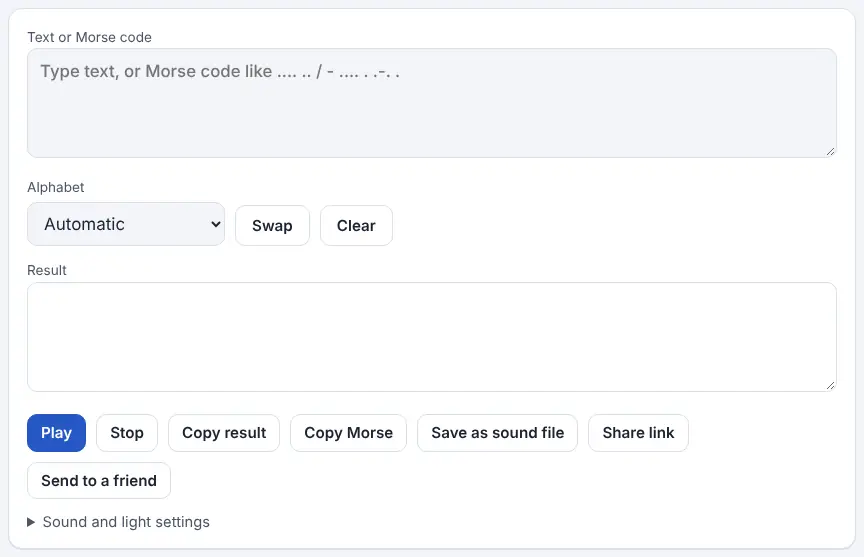
The Hello in Morse Code page on Unscramble Words 4U shows the greeting in dots and dashes and includes the full Morse translator, so you can play the word as beeps, flash it on screen, vibrate it on a phone, copy it, save it as a WAV sound file or turn it into a shareable postcard link. Because the translator works both ways, learners can also change the word, type their own greeting or paste in Morse to read.
Broken down, H is four dots, E is a single dot, each L is dot-dash-dot-dot, and O is three dashes. Those letters are some of the most frequently used in English, which makes HELLO a useful way in. The page also introduces a few friendly radio-operator signals: CQ, a general call inviting anyone listening to reply; HI, used as a laugh; and 73, meaning best regards when signing off. It is a lovely starting point for a short lesson on how people greet each other across distance.
How to use it
- Open the page – HELLO and its Morse code are shown at the top.
- Type HELLO, or any other word, into the box to see it translated.
- Press Play to hear it. Use the sound and light settings to slow it down for beginners.
- Tick the flash option to watch the light pattern, or vibrate on a supported phone.
- Save the sound file for a lesson, or use Send to a friend to make a postcard link with an optional nickname.
- Try keying HELLO yourself on the Morse decoder to check your timing.
More tips
- HELLO is a good warm-up for keying practice because the repeated L lets pupils check they are consistent.
- Use HI (.... ..) as an even shorter greeting for very young learners.
Ideas for the classroom and home learning
- KS1 (5–7)Greeting circle: play HELLO each morning and let children ‘answer’ with HI by tapping four times, pausing, then tapping twice.
- KS2 (7–11)Hello around the world: pupils find how to say hello in languages spoken in the class, then translate their favourites into Morse and display them.
- KS2 (7–11)Telegraph history: explain that the electric telegraph let messages cross countries in moments in the 1800s. Pupils write a ten-word telegram greeting.
- KS3 (11–14)Communication protocols: use CQ and 73 to discuss how radio operators agree shared codes, then design a class sign-on and sign-off.
Questions
How do you write hello in Morse code?
.... . .-.. .-.. --- – that is H, E, L, L, O, with a small gap between each letter.
How do radio amateurs say goodbye?
They often send 73, which stands for best regards.
Can my class send HELLO to another class?
Yes. Use the postcard option to create a link and share it with a partner class you know. The message is held inside the link itself, so nothing is stored on the website.
Opens Unscramble Words 4U, our free word-puzzle site, in a new tab. Free, with no sign-up.
Share postcard links only with people you know. Flashing light can affect people with photosensitive epilepsy, so check before using the flash or torch modes.