

Binary Translator
See how a computer stores words as strings of 0s and 1s, and turn binary back into readable text.
Opens Unscramble Words 4U, our free word-puzzle site, in a new tab. Free, with no sign-up.
What it does
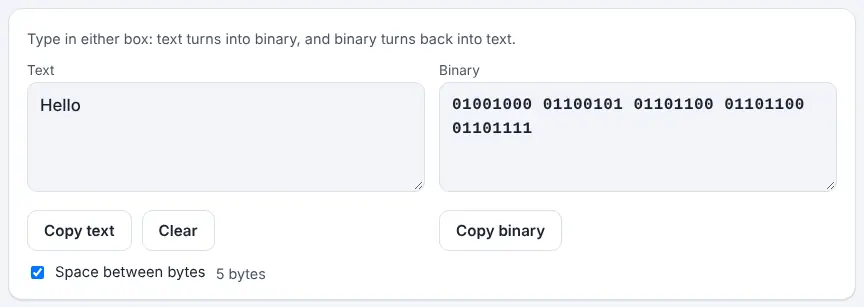
The tool has two linked boxes. Type in the Text box and the Binary box fills with groups of eight digits, one group per byte; paste binary into the Binary box and readable text appears. For example, Cat becomes 01000011 01100001 01110100. A tick box (on by default) puts a space between bytes; untick it for one unbroken string. When reading binary, bytes may be split by spaces, commas or line breaks, or joined into one run provided the digit count divides by eight.
Text is handled as UTF-8, the encoding nearly every website uses. Everyday English characters fit in a single byte, é and other accented letters use two, and an emoji needs four, so a single emoji produces 32 digits. There are separate copy buttons for each box and a Clear button. It is a hands-on way into how data is represented, a core idea in computing.
How to use it
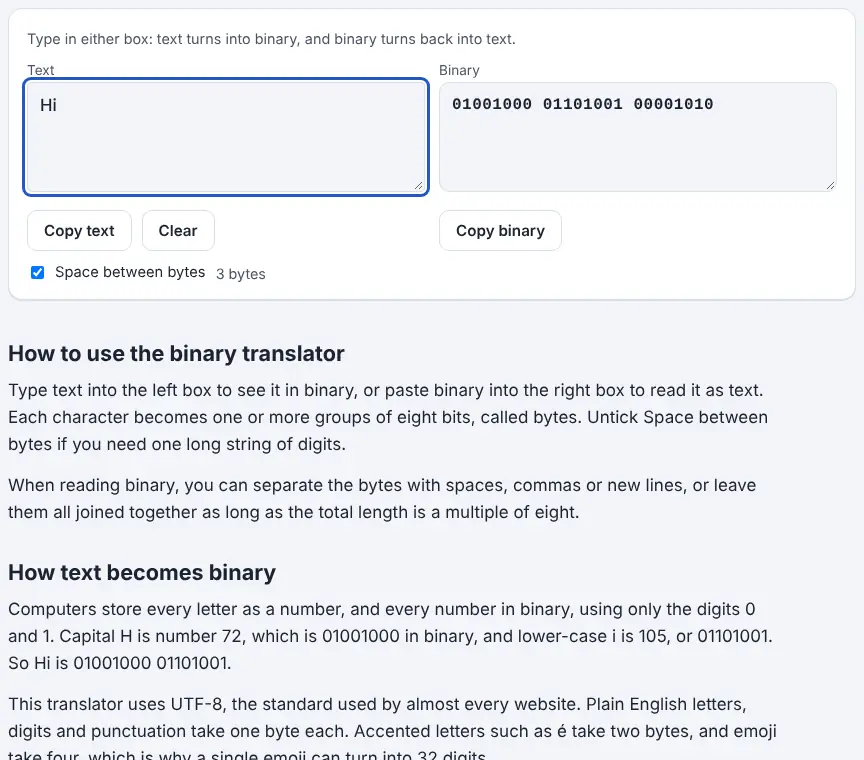
- Type a word in the Text box and watch the binary appear alongside.
- Untick the byte-spacing option if you need the digits run together.
- To decode, paste binary into the Binary box; the text appears in the other box.
- Use the copy button under whichever box you need, or Clear to empty both.
More tips
- If binary turns into odd symbols, a digit is probably missing; check the total is a multiple of eight.
Ideas for the classroom and home learning
- KS2 (7–11)Binary bracelets: pupils find the binary for their initials and thread two colours of beads for 0 and 1.
- KS3 (11–14)Convert one byte by hand using place values, then check with the tool; build up to a whole word.
- KS3 (11–14)Compare how many bytes a plain word, an accented word and an emoji need, and discuss why.
- KS4 (14–16)Explore UTF-8 encoding and character sets, using the tool to test predictions about byte counts.
Questions
What are bits and bytes?
A bit is a single binary digit. Eight of them make a byte, which can hold any number from 0 to 255.
Why does my binary decode into strange symbols?
Usually a digit has been lost or added, so the bytes no longer line up. Count the digits.
Does it work with emoji?
Yes. Each emoji uses four bytes in UTF-8, giving 32 binary digits.
Is binary a secret code?
No. It is simply how computers store data, and anyone can convert it back.
Opens Unscramble Words 4U, our free word-puzzle site, in a new tab. Free, with no sign-up.
Binary is a way of representing data, not a way of protecting it. Do not use it to hide passwords or personal details.