

Cipher Decoder
Got a coded message but no idea how it was made? The cipher decoder tries the usual suspects for you and puts the most readable answer first.
Opens Unscramble Words 4U, our free word-puzzle site, in a new tab. Free, with no sign-up.
What it does
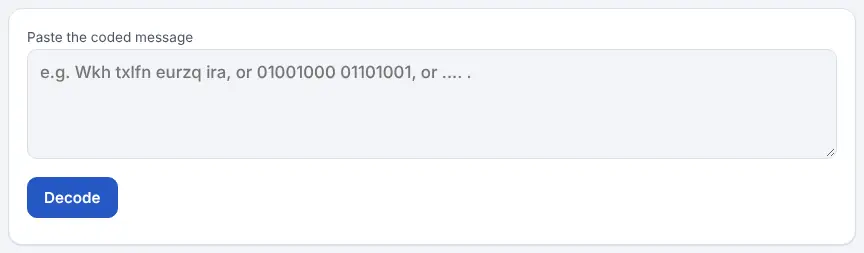
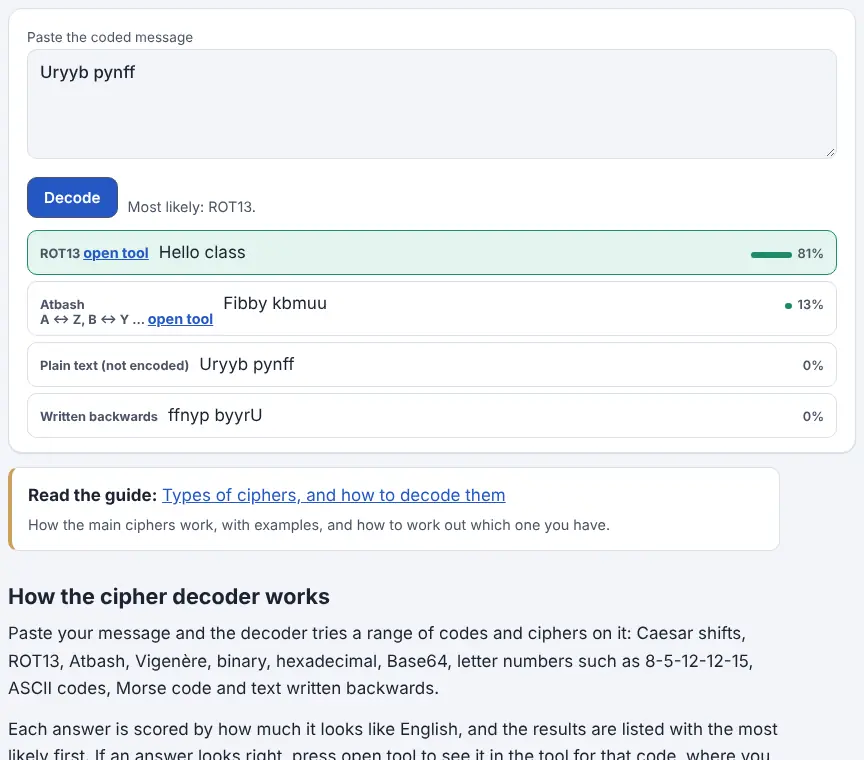
You paste in a mystery message and press Decode. The tool then runs it through a set of common methods: computer encodings (binary, hex, Base64 and ASCII), the A1Z26 number code, Morse, letter shifts including ROT13, the Atbash mirror alphabet, Vigenère when the text is long enough, and plain backwards writing. Every attempt gets a score for how closely it resembles English, and the list is sorted so the strongest match sits at the top.
When one result reads properly, you can jump straight to the matching tool to adjust settings or write a reply in the same code. It is a brilliant detective tool for escape rooms and puzzle hunts, and a good way to show learners that many old ciphers can be spotted and undone by a computer in moments.
How to use it
- Copy the whole coded message, not just one word, and paste it into the box.
- Press Decode.
- Read down the ranked answers; the most English-looking one is listed first.
- If one makes sense, use its open tool link to see it in the dedicated tool for that code.
- If none make sense, check the clues below and try a specialist tool such as the cryptogram solver.
More tips
- If every answer is nonsense, the message may use a random letter swap or a secret key, which needs a different approach.
Ideas for the classroom and homeschool
- Grades 3–5Set a 'mystery envelope' challenge with messages in different codes. Groups predict the code by eye first, then check with the decoder.
- Grades 6–8In computer science, discuss how a program can 'score' text as English, linking to letter frequency and common words.
- Grades 6–8Ask students to write a message the decoder cannot crack, then explain why it worked, introducing the idea of keys.
- Grades 9–12Compare the decoder's success on short and long messages and write up why sample size matters in analysis.
Questions
Which codes does it check?
Shift ciphers (ROT13 among them), Atbash, Vigenère for longer passages, Morse, A1Z26 number messages, ASCII, binary, hex, Base64 and reversed text.
Why does every answer have a low score?
The message could be very short, written in another language, or made with a keyed or random-swap cipher. For random letter swaps, the cryptogram solver is the better choice.
Does it send the message anywhere?
No. The checks happen in the browser on your own device.
What about symbol scripts like pigpen or runes?
Those are drawn or special characters, so use the pigpen, rune or braille tools instead.
Opens Unscramble Words 4U, our free word-puzzle site, in a new tab. Free, with no sign-up.
Classic ciphers offer no real protection. The decoder is for puzzles and learning, and it cannot break modern encryption.