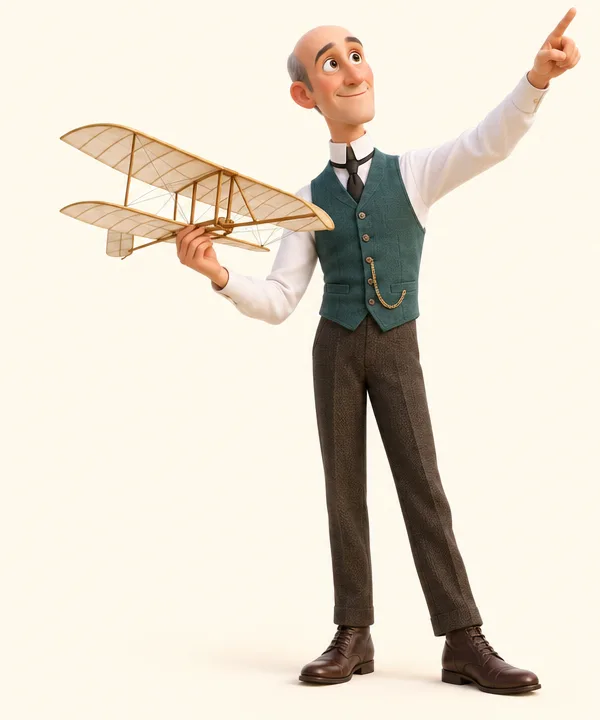
Ask Mr Wilbur
Aviate, navigate, communicate
Questions about flying, sent in by learners, answered by Mr Wilbur, Head of Aviation in our Aviation Department.
Education and interest only. Classfern teaches aviation as a school subject. It is not flight training, not an approved training organisation, and nothing here counts towards a pilot licence or replaces a CAA-approved course and the CAA’s own exams.
Questions and answers
- How does an aeroplane stay up in the air?
- How far did the Wright brothers fly on their first day of powered flight?
- How do pilots spell out words on the radio?
- What is a stall? Does it mean the plane has broken down?
- When did people first fly in a balloon?
How does an aeroplane stay up in the air?
Mr Wilbur says:
Four forces act on an aeroplane while it flies: lift, weight, thrust and drag. Weight is gravity pulling the aeroplane towards the centre of the Earth. Thrust from the propellers or jet engines pushes it forwards, and drag is the air pushing back against it.
Lift comes mostly from the wings. As the aeroplane moves, the wings turn the moving air, and the air pushes back on the wings – both the top and the bottom of the wing help. When lift balances weight, the aeroplane stays up.
You may hear that the air over the top of a wing has to "catch up" with the air underneath. NASA explains that this idea is wrong: the air over the top actually reaches the back of the wing first.
Where this comes from: NASA – Four Forces of Flight (STEM activity); NASA Glenn Research Center – Four Forces on an Airplane; NASA Glenn Research Center – What is Lift?; NASA Glenn Research Center – Incorrect Lift Theory (equal transit).
How far did the Wright brothers fly on their first day of powered flight?
Mr Wilbur says:
On 17 December 1903 Wilbur and Orville Wright made four flights in their Flyer on the Outer Banks of North Carolina, where they had already made over a thousand glides from Big Kill Devil Hill. The wind was blowing at 27 mph.
Orville released the wire holding the Flyer at 10:35, and that first flight landed about 37 metres (120 feet) from the launching rail. The longest flight was the fourth, flown by Wilbur: it lasted 59 seconds and covered about 260 metres (852 feet). Soon afterwards a gust of wind rolled the Flyer over and damaged it.
Where this comes from: US National Park Service – The First Flight (Wright Brothers National Memorial).
How do pilots spell out words on the radio?
Mr Wilbur says:
Pilots and air traffic controllers use a phonetic alphabet, where every letter has its own word: Alfa, Bravo, Charlie, Delta, Echo, Foxtrot, Golf, Hotel, India, Juliett, Kilo, Lima, Mike, November, Oscar, Papa, Quebec, Romeo, Sierra, Tango, Uniform, Victor, Whiskey, X-ray, Yankee and Zulu. So the word "CAB" would be spelt "Charlie Alfa Bravo".
Some numbers are said in a special way too: 3 is "tree", 5 is "fife" and 9 is "niner". For a decimal point, ICAO procedures say "decimal", while pilots in the United States say "point".
Where this comes from: FAA Aeronautical Information Manual, chapter 4 section 2 (radio phraseology).
What is a stall? Does it mean the plane has broken down?
Mr Wilbur says:
No. In flying, a stall is about the wing and the air. A wing meets the oncoming air at an angle called the angle of attack. As that angle gets bigger, the wing makes more lift – but only up to the critical angle of attack, which is usually about 16 to 20 degrees, depending on the design.
Go past the critical angle and lift drops off quickly: that is a stall. It can happen at any speed and with the nose pointing in any direction, and a given aircraft always stalls at the same angle of attack. In a turn the wing has to make extra lift, so the stall speed goes up.
Where this comes from: FAA Pilot's Handbook of Aeronautical Knowledge, chapter 5 (Aerodynamics of Flight).
When did people first fly in a balloon?
Mr Wilbur says:
The first recorded balloon flight with people on board was on 21 November 1783, in a Montgolfier hot air balloon. De Rozier and d'Arlandes flew for 23 minutes and travelled about 9 kilometres (5.5 miles).
Ten days later, Jacques Charles flew the first gas balloon, filled with hydrogen. It stayed up for 2 hours, went about 43 kilometres (27 miles) and climbed to about 2,700 metres (9,000 feet) – about 120 years before the Wright brothers' first powered flights.
Where this comes from: FAA Balloon Flying Handbook, chapter 2.